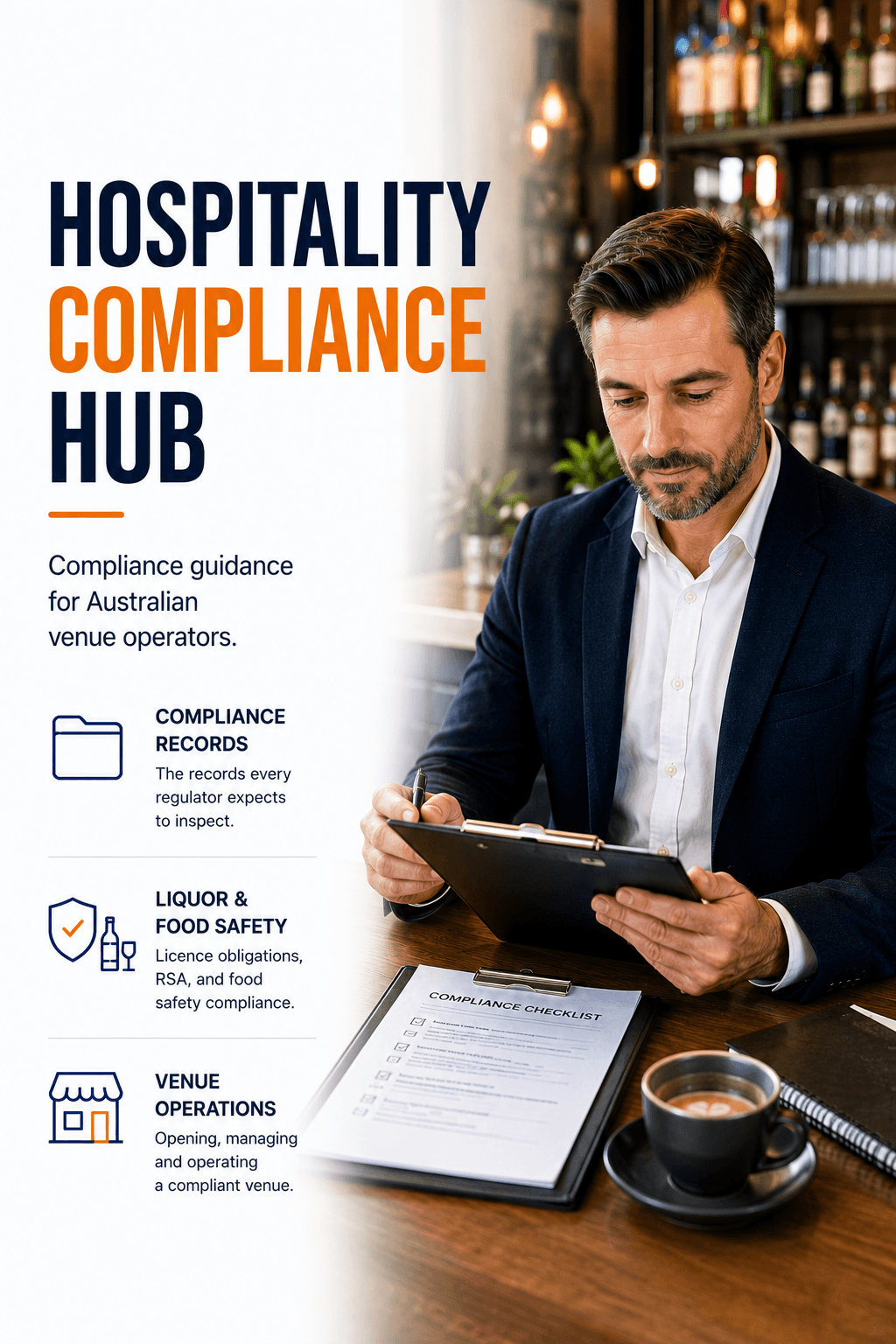
Hospitality Compliance Hub — The Complete Reference for Australian Venue Operators







Access All Areas Training | RTO 52312 | NSW Food Authority Approved Provider 25813 | accessallareastraining.com.au | 1300 287 554
Last reviewed: July 2026 | General guidance only — verify current obligations with the relevant regulator
About This Guide
This guide is written for people who carry formal compliance responsibility for licensed hospitality venues in Australia — venue managers, licensees, operators, multi-site group HR teams, and anyone who deals with regulators, Fair Work inspectors, or compliance audits on behalf of a food and beverage business.
It is not for first-time RSA students. The RSA Training Hub, the Food Safety Training Hub, and the WA Approved Manager Training Hub cover the student-facing training pathways in detail. This guide covers the five compliance domains that determine whether a venue can lawfully trade and keep trading: employment awards and wages, liquor licensing obligations, workplace health and safety, the process of opening a licensed venue, and the ongoing employer records every regulator expects to inspect.
Every claim in this guide is verified against primary sources — Fair Work legislation and pay guides, state liquor regulator guidance, FSANZ standards, and state WHS Acts. Where figures or requirements are subject to annual change, the relevant official source is cited so you can confirm the current version before acting on it.
DISCLAIMER: This guide provides general compliance information only. It is not legal, financial, payroll, or industrial relations advice. Verify current obligations with the relevant regulator or a qualified professional before making compliance decisions. Information is current as at July 2026.
1. Employment Awards — HIGA and the Restaurant Award
The Hospitality Industry (General) Award 2020 (HIGA, award code MA000009) covers employees in hotels, pubs, taverns, bars, bottle shops, resorts, casinos, caravan parks, and catering businesses where hospitality services are the primary focus. It is the most operationally complex award in the industry — combining split shifts, evening and night loadings, weekend and public holiday penalties, casual loading, and a long list of allowances that interact with each other in ways that regularly trip up payroll systems configured without expert input.
The Restaurant Industry Award 2020 (MA000119) covers employees in restaurants, cafes, and bistros where the primary activity is the preparation and table-service of meals to seated customers. The rule of thumb: if customers predominantly order at a counter and collect their own food and drink, HIGA or the Fast Food Award is more likely to apply. If staff take orders at tables, bring meals and drinks to seated customers, and meals are the primary business activity, the Restaurant Award is more likely to apply.
Two awards that are frequently confused with HIGA are also worth knowing. The Clubs Award 2010 (MA000058) covers registered clubs — RSLs, sporting clubs, and golf clubs — and should not be applied to commercial hotels, bars, or restaurants. The Fast Food Industry Award 2010 (MA000003) covers counter-service operations and should not be applied to table-service venues.
The practical starting point before setting any pay rates: confirm your award coverage using the Fair Work Pay and Conditions Tool (PACT) at fairwork.gov.au/pay-and-conditions-tool. The tool takes approximately three minutes to use and gives a definitive answer. Do not rely on industry assumptions, what the previous owner told you, or what a payroll software default suggests. Award misapplication discovered by a Fair Work inspector makes every single pay calculation wrong retrospectively, and back-pay obligations extend for up to six years.
HIGA classifies employees by the actual duties they perform and the skill level those duties require — not by their job title. A person with the job title "bar manager" who trains new staff and independently manages product ordering sits in a higher classification than an entry-level bar attendant, regardless of what either person's employment contract says. Classifying employees too low is underpayment, and it is the employer's obligation to classify correctly.
The classification structure runs from Introductory Level through Level 1 (the baseline classification for most entry-level hospitality roles) up through Levels 2, 3, 4, 5, and 6, plus a separate Managerial Staff (Hotels) stream for genuine hotel managers. Each level carries a minimum hourly rate that increases from the first full pay period on or after 1 July each year following the Fair Work Commission's Annual Wage Review.
The 2026 Annual Wage Review increased all modern award minimum rates by 4.75%, effective the first full pay period on or after 1 July 2026. At Level 1 — the classification that covers most entry-level bar attendants, food and beverage attendants, and kitchen hands — the 2026/27 adult full-time and part-time rate is $26.44 per hour. The Level 1 casual rate, which includes the 25% casual loading applied on top of the base rate, is $33.05 per hour. These figures are drawn from the Fair Work Ombudsman's official HIGA pay guide published on 24 June 2026. Confirm the current rates for every classification level your business uses at fairwork.gov.au/pay-and-wages/minimum-wages/pay-guides before each new financial year.
The Introductory Level classification applies only during an employee's first three months of employment where they have no prior relevant experience. It is not a permanent classification and cannot be applied indefinitely to reduce wages. After three months, or earlier if the employee demonstrates the competencies of Level 1, they must be reclassified upward.
Managerial Staff (Hotels) is a separate, salaried stream for employees who genuinely manage a department or the venue itself. The minimum annual salary for this stream must be verified against the current HIGA pay guide — it is updated annually and cannot be set as a permanent fixed figure in an employment contract without building in an annual review mechanism.
Penalty rates are the area of HIGA most frequently misapplied. The award overlays several different rate types on top of the base hourly rate, and they interact with each other in ways that are not intuitive if you're accustomed to a simple weekend loading system.
Standard hours under HIGA are Monday to Friday, 7:00am to 7:00pm. Work performed within these hours attracts the ordinary rate for full-time and part-time employees. Casual employees always receive their base rate plus 25% casual loading — the $33.05 figure at Level 1 — during standard hours.
Evening work, defined as Monday to Friday between 7:00pm and midnight, attracts a flat dollar loading of $2.81 per hour on top of the ordinary rate as at the 2026/27 pay guide. This is a critical point that payroll systems regularly get wrong: the evening loading under HIGA is a flat dollar amount, not a percentage of the base rate. Applying it as a percentage systematically underpays every employee who works evening shifts, and the error compounds over time. Confirm the current flat dollar amount from the official HIGA pay guide before configuring your payroll.
Night work — midnight to 7:00am Monday to Friday — attracts a higher flat loading of $4.22 per hour as at the 2026/27 pay guide. Again: flat dollar, not a percentage.
Saturday work attracts 150% of the ordinary rate for full-time and part-time employees, and 175% for casuals (which is the casual Saturday rate — their base casual rate plus the Saturday loading). Sunday work attracts 175% for full-time and part-time employees, and 200% for casuals. Public holiday work attracts 250% for full-time and part-time employees, and 275% for casuals.
Overtime is payable at 150% for the first two overtime hours on any day, and 200% thereafter. For casual employees, overtime rules differ and PACT should be used to calculate correctly.
The split shift allowance applies when a shift is split into two or more parts with an unpaid break of more than the ordinary meal break entitlement between them. A specific dollar allowance applies — confirm the current amount from the HIGA pay guide — and this is one of the most commonly overlooked entitlements in venues that split staff across lunch and dinner services.
The interaction of casual loading with penalty rates is where the most serious systematic errors occur in hospitality payroll. Casual loading is applied to the base rate first, producing the casual base rate. Penalty percentages then apply to the casual base rate, not the ordinary rate. An employer who applies Saturday penalty percentages to the ordinary rate rather than the casual base rate underpays every casual on every Saturday shift.
The Fair Work Ombudsman's enforcement history across the hospitality industry consistently identifies the same failure patterns. If any of the following apply to your business, review your payroll before an inspector does.
Using a flat all-in casual rate for all hours is the most widespread error. A single hourly rate applied regardless of the day and time will almost always underpay on Saturdays, Sundays, public holidays, and evenings. The only all-in rate that satisfies the award is one that has been formally agreed as an annualised salary under the award's annualised salary provisions — and those provisions have strict requirements and annual reconciliation obligations.
Applying the wrong award makes every calculation wrong from the start. The second most common error, particularly for businesses that span both accommodation and food service, or that operate as part of a hotel group.
Not updating rates on 1 July. Award rates increase every year, typically from the first full pay period on or after 1 July. Using last year's rates from day one of the new financial year is underpayment from day one. Set a recurring calendar reminder for 30 June each year, download the new pay guide, and update payroll before the new rates take effect.
Classifying employees at too low a level. Employees who train new staff, open or close the venue unsupervised, manage sections independently, or perform duties that require experience and initiative are frequently left at Level 1 when their duties clearly put them at Level 2 or above. The classification descriptions in the award text are the reference — not assumptions about what seems reasonable.
Applying the evening loading as a percentage rather than the flat dollar amount specified in the award. This is a payroll configuration error that affects every evening shift.
Not paying for all time the employee is required to be at or near the workplace. Pre-shift setup time, end-of-shift cleaning, and briefings before or after a rostered shift are all time the employee must be paid for if management requires them to perform those tasks.
Treating trial shifts as unpaid. A trial shift that involves performing the actual work of the role — taking orders, working a bar service, preparing food — must be paid at award rates. A brief skills assessment (typically no more than an hour) may be unpaid, but a full shift is not a legitimate unpaid trial regardless of what the employer calls it or what the candidate agrees to.
Not applying the split shift allowance. Venues that roster staff across a split lunch-and-dinner service frequently omit this allowance, either because they are unaware it exists or because payroll software is not configured to trigger it.
The Fair Work Act was amended in 2024 to clarify the definition of a casual employee. A casual employee is now defined by the absence of a firm advance commitment to continuing and indefinite work — and the test looks at the practical reality of the employment relationship, not just what the contract says. An employee who has worked regular and systematic shifts for six months or more and has a reasonable expectation of ongoing work may have entitlements that look more like permanent employment than casual engagement, regardless of what their contract says.
After six months of regular and systematic employment — or twelve months for small business employers — a casual employee may be entitled to request conversion to permanent (full-time or part-time) employment. Employers must issue casual conversion notices to eligible employees at the appropriate time and cannot unreasonably refuse a conversion request.
The practical implication for hospitality operators: if you have casual employees with regular, predictable rosters who have been engaged for six months or more, review their entitlements against the updated casual definition before assuming their engagement arrangement is straightforward.
Under the Fair Work Act and Fair Work Regulations, all employers must keep employment records for seven years and produce them to a Fair Work inspector within the timeframe specified in the inspector's request — typically three business days. Failure to keep and produce records is a standalone offence, separate from any underlying underpayment. An employer can be fined for inadequate records even if wages were paid correctly.
Employment records must include the employee's name, classification, employment type (full-time, part-time, or casual), date of engagement, and commencement date. Pay records must capture gross and net pay, the pay period, deductions, allowances, and superannuation contributions. Time records must show the start and finish time of each shift and the total hours worked — this applies to salaried managers as well as hourly workers, and is the requirement that most employers of salaried staff fail to meet.
Payslips must be issued within one working day of each pay period. They must include the employer's name and ABN, the employee's name, the pay period, gross earnings, any deductions, net earnings, the hourly rate (where applicable), and superannuation contributions made during the period. A payslip that omits any of these elements is non-compliant regardless of whether the underlying payment was correct.
Leave records must capture accruals and dates taken for annual leave, personal and carer's leave, and long service leave. Individual Flexibility Arrangements must be kept in writing, signed by both parties, and demonstrate that the employee is better off overall compared to the award entitlements they are varying.
Summary: Most hospitality employees in Australia are covered by one of two modern awards made by the Fair Work Commission. Getting the award right is the foundation of payroll compliance. Applying the wrong award — or misunderstanding the penalty rate structure within the correct award — is the single most common cause of underpayment in the hospitality industry. The Fair Work Ombudsman has taken enforcement action against major hospitality chains, small independents, and franchisees across every state for award misapplication. The consequences include back-pay orders, civil penalties, and public naming.
2. Liquor Licensing Obligations by State
New South Wales has fourteen liquor licence categories. The most common for hospitality operators are the on-premises licence (for restaurants and bars), the hotel licence (for pubs, taverns, and accommodation venues with bar service), the small bar licence (for intimate venues with up to 120 patrons and no gaming machines), and the packaged liquor licence (for bottle shops and retail off-licence premises).
The RSA competency card is the foundational obligation for all NSW licence holders. Every staff member who serves, supplies, or supervises the service of alcohol must hold a current L&GNSW RSA Competency Card — not just a Statement of Attainment. The card is a separate step from completing the RSA course: after completing SITHFAB021 with an approved provider such as AAAT and receiving the Statement of Attainment and interim certificate (valid for 90 days), staff must apply for the competency card at a Service NSW service centre within the 90-day window. The card is valid for five years. Staff must carry it at work and produce it to police or L&GNSW inspectors on request. An interim certificate alone is not sufficient for ongoing employment in a licensed venue after the 90-day period expires.
The Liquor Plan of Management (LPoM) is a written document that all on-premises and hotel licensees must maintain. It outlines how the venue manages RSA obligations, intoxication, minor entry, security arrangements, patron limits, noise, incident response, and promotional activities. The LPoM must be consistent with the licence conditions and must be updated whenever the business model or licence conditions change. A failure to maintain an LPoM, or a LPoM that does not reflect actual operating practices, is a compliance failure. L&GNSW inspectors will request the LPoM during a compliance visit and assess whether operational reality matches the documented plan.
The incident register is a mandatory record for most NSW licence holders and all venues trading past midnight. It must record every incident involving intoxication, violence, theft, drug use, banning, or patron ejection. The register must be maintained in a form approved by L&GNSW — either the approved bound book or a digital platform that meets the same standards — and must be available for inspection by police and L&GNSW at any time the venue is trading. A register that has not been maintained, or that contains incomplete or inconsistent entries, is a compliance failure.
From 1 March 2025, two new NSW requirements came into effect that affect specific licence types. Restaurants wishing to sell takeaway or home-delivery liquor must hold a Takeaway Alcohol Authorisation from L&GNSW — selling liquor for delivery without this authorisation is unlawful. Separately, staff involved in same-day alcohol delivery (including drivers working for platforms such as Uber Eats or DoorDash delivering on behalf of packaged liquor licensees) must hold Responsible Supply of Alcohol Training (RSAT) certification.
Most new NSW licence applications are subject to a 30-day public notification period during which police, council, neighbouring residents, and community organisations can lodge objections. Objections extend the application timeline significantly and may result in additional licence conditions being imposed. The regulator considers the density of existing licences in the area, the potential impact on community amenity, the compliance history of the applicant, and the local crime environment when assessing applications and setting conditions.
Development consent from the local council is required before a liquor licence application can succeed in NSW. The DA must confirm that the use of the premises as a licensed venue — including the proposed trading hours and the intended type of service — is permissible under the relevant planning instrument. The sequence is: DA first, then liquor licence application. Applicants who reverse this sequence or who lodge a liquor licence application before the DA is determined face rejection.
Liquor Control Victoria (LCV) administers licensing under the Liquor Control Reform Act 1998 (Vic). Victoria's regulatory framework is distinctive in two respects: the demerit point and star rating system that directly affects licence renewal fees and can trigger suspension, and the mandatory two-step RSA training requirement that has applied since December 2025.
The Victorian RSA requirement is two steps and both are mandatory. Step one is completing SITHFAB021 with an LCV-approved provider — AAAT is LCV approved. Step two is completing the free mandatory module through the LCV Learning Hub at learninghub.liquor.vic.gov.au. The LCV module is free, administered directly by the regulator, and must be completed in addition to the provider course — it is not a replacement for the course. A staff member who has completed only one of the two steps is not RSA compliant in Victoria. The LCV Certificate of Completion is valid for three years, after which the LCV refresher module must be completed again — also free, also direct through LCV. Employers should not pay a private RTO to deliver a VIC RSA refresher course: the refresher is a direct LCV obligation, not a provider-delivered course.
The red line plan defines the authorised area — the exact boundaries of the licensed premises within which alcohol may be served and consumed. Alcohol cannot be served outside the red line area, and patrons cannot take drinks outside it. Footpath dining, lane-way areas, and rooftop spaces require separate council approval before LCV can approve them as part of the authorised area. Trading outside the red line area — whether by serving drinks in an unapproved area or allowing patrons to take drinks beyond the boundary — is a breach that can attract a demerit point.
Victoria's demerit point system is tied to six specific high-harm offences under the Liquor Control Reform Act 1998. When a non-compliance incident is detected and either an infringement notice is paid or an enforcement order is issued, one demerit point is recorded against the licence. Each demerit point remains on the licence for three years and substantially increases annual renewal fees. Licence suspension is automatic at defined point thresholds within a three-year period. If a licensee receives a demerit point, they must complete Advanced RSA training through LCV within six months of the point being recorded.
The star rating is a public-facing measure of compliance that LCV publishes and that affects renewal fees through a discount structure. Licensees with no recorded demerit points within two or more years receive star rating fee discounts. A low star rating, published publicly and searchable by licence number, signals a compliance history to regulators, police, council, and the community.
Victoria requires licensees to provide free drinking water to patrons in any venue that supplies alcohol for consumption on-site. This is a statutory obligation, not a recommendation, and applies regardless of venue type or size. Failure to provide free water when requested by a patron is a breach.
Late-night trading — operating past 1:00am — requires a separate licence category (late night general or late night on-premises) and substantially higher annual fees reflecting the increased harm risk associated with extended trading. Venues in certain council areas including Stonnington must provide additional documents when applying for late-night licences, including a noise mitigation strategy, a gender-based violence prevention and response plan, and documented compliance history with liquor laws and EPA noise regulations.
OLGR administers liquor licensing under the Liquor Act 1992 (Qld). Queensland's compliance framework is distinguished by its mandatory CCTV obligations for many venue types, the Responsible Management of Licensed Venues (RMLV) requirement for approved managers, the Risk Assessed Management Plan (RAMP) that most licence categories require, and the Safe Night Precinct (SNP) requirements that apply in designated areas of certain cities.
RSA in Queensland must be completed through an OLGR-approved provider. AAAT is an OLGR-approved RSA provider. Completion through a non-approved provider does not satisfy the Queensland requirement regardless of whether the underlying unit (SITHFAB021) is the same nationally accredited unit delivered by every legitimate RSA provider in Australia.
The RMLV (Responsible Management of Licensed Venues) is a Queensland-specific management training requirement separate from RSA. Many Queensland licence categories require that a person holding RMLV approval be present or reasonably available during trading. RMLV is not the same as the WA Approved Manager qualification and does not apply outside Queensland. Licensees should confirm whether their licence category requires an RMLV-approved manager to be on duty during trading hours.
The RAMP (Risk Assessed Management Plan) documents how the venue manages entry, security, patron intoxication, incidents, glassware, noise, transport options for departing patrons, and the roles and responsibilities of staff and security personnel. The RAMP must match how the venue actually operates — an OLGR inspector who visits and finds the RAMP does not reflect current operational reality will treat the discrepancy as a compliance failure. The RAMP must be available for inspection by OLGR at any time the venue is trading.
Queensland's CCTV obligations apply to many licensed venues and are among the most specific in the country. CCTV recordings must be retained for a minimum of 28 days, and any recording that captures an incident (violence, theft, drug use, patron ejection, or any other prescribed event) must be retained for at least one year after the initial 28-day retention period. Recordings cannot be deleted while an OLGR investigator or police officer has indicated they may wish to view them. CCTV equipment must be checked by the licensee or approved manager before 12:30am on each trading day to confirm it is operational. At least every six months, a licensed security equipment installer must inspect, certify, and record the condition of the CCTV equipment in a CCTV review register. This register must be kept on-site and made available to OLGR inspectors on request. Facial recognition technology may be used but must delete data that does not match a banned or excluded patron.
Safe Night Precincts are designated geographic areas — primarily in Brisbane, the Gold Coast, and other major urban centres — where additional obligations apply during specified trading hours. In SNPs, venues that trade after midnight may be required to operate an OLGR-approved ID scanning system, connected to the banned patron register, during the SNP trading period. ID scanning obligations are tightly prescribed, including what information may be captured, how long it must be retained, and the privacy obligations that attach to the personal information collected.
The Liquor Control Act 1988 (WA) governs liquor licensing in Western Australia, administered by the Department of Local Government, Sport and Cultural Industries (DLGSC) through its Liquor and Gaming division (formerly LGIRS). Western Australia is the only state that requires a separate Approved Manager qualification for formally appointed venue managers, distinct from RSA and not required in any other Australian jurisdiction.
RSA in WA must be from a DLGSC-recognised provider. AAAT is recognised in WA. The RSA Statement of Attainment must be retained by the licensee in a training register alongside the records of all other serving staff. There is no formal expiry on a WA RSA Statement of Attainment once obtained, but the 28-day rule applies to new employees: a person who starts work at a licensed venue in WA must complete RSA within 28 days of their first shift.
The WA Approved Manager card (obtained by completing the MLPLCA001 qualification) is required for anyone formally appointed as the Approved Manager of a licensed premises in WA. The card covers the Liquor Control Act 1988, the obligations of the Approved Manager role, responsible service obligations, and venue compliance. To obtain an unrestricted card — which authorises management of any category of licensed premises — RSA is a prerequisite: MLPLCA001 cannot be commenced without a current RSA Statement of Attainment. The card is valid for five years and must be renewed before expiry. Application requires a National Police Certificate no older than three months and lodgement at a WA Post Office.
An Approved Manager must be present at the licensed premises at all times when business is being conducted. This is a statutory obligation under section 100(2a) of the Liquor Control Act 1988 (WA), not a recommendation. If the Approved Manager is absent for more than three consecutive days, the licensee must either appoint a Temporary Approved Manager (who must also hold a current card) or notify DLGSC. Operating a licensed venue without a compliant Approved Manager on the premises during trading is a breach that can result in enforcement action and licence conditions.
South Australia is regulated by Consumer and Business Services (CBS) under the Liquor Licensing Act 1997 (SA). RSA training must be from a CBS-approved provider — AAAT is CBS approved. Licensees must maintain RSA training registers for all serving staff and comply with licence-specific conditions. SA has been developing regulatory responses to liquor-related harm through 2025-2026, including proposed restrictions on certain high-risk alcohol products and delivery models. Operators should monitor CBS for new requirements as these changes are implemented.
Tasmania is regulated by Treasury and Finance under the Liquor Licensing Act 1990 (Tas). RSA is required for all serving staff. The key rule for new employees: they must be enrolled in and actively completing an approved RSA course within three months of starting work at a licensed venue. Licence fees are due annually by 31 March. Late payment attracts a 10% surcharge; continued non-payment can result in licence suspension or cancellation.
The Northern Territory is regulated by Licensing NT under the NT Liquor Act 2019. RSA is mandatory and must be refreshed every three years. This is the correct current figure — three years — per nt.gov.au and verified against independent sources. A third-party website (ntrefreshrsa.com, operated by Hospitality NT) states a different figure; nt.gov.au is the authoritative source. The NT also has extensive Alcohol Management Plans covering many regions, with dry area declarations and supply restrictions that apply in addition to standard licence conditions. Supplying alcohol in or to a declared dry area is a serious criminal offence. Operators must verify the current dry area boundaries for their location and for any delivery operations they conduct.
The Australian Capital Territory is regulated by Access Canberra under the ACT Liquor Act 2010. RSA is required for all serving staff and must be refreshed every three years. AAAT is an Access Canberra approved RSA provider. The ACT has been progressing amendments to its liquor laws through 2026 — operators should monitor Access Canberra for implementation dates and new obligations as these changes come into effect.
Regardless of whether CCTV is a specific licence condition, operating a licensed venue without any systematic documentation of incidents, refusals, and patron management is a compliance risk. In the event of a regulatory investigation, a licensing inquiry, or a civil claim, the absence of contemporaneous records will work against the licensee. The following records should be maintained by every licensed venue, even where specific regulations do not mandate them.
The RSA training register must be live at all times. It should record every serving staff member's name, role, state-specific RSA course completed, date of completion, certificate or card number, expiry date (where the state requires renewal), and the date management last verified the certificate is current. In NSW, management should conduct random spot checks to confirm staff are carrying their competency card during shifts. A gap in the register — a staff member who has been serving alcohol without current RSA — is a direct breach of licence conditions in every state.
The incident register should record every incident involving intoxication, violence, theft, drug use, patron ejection, or police attendance. Entries should be made promptly and include the date, time, a factual description of the incident, the names of staff involved, and the outcome. Managers should review register entries regularly to identify patterns that indicate a systemic problem with patron management or venue risk.
The refusal register records every refusal of service or entry. It should capture the date, time, an approximate description of the patron (without retaining personal information where this is not required), the reason for refusal, and the staff member who made the refusal. A consistent refusal register demonstrates a culture of responsible service and is important evidence in any licensing inquiry about the venue's RSA practices.
CCTV footage retention should follow the most stringent requirement applicable to the venue's jurisdiction and licence conditions. As a minimum across all states: retain non-incident footage for 28 days. Retain footage of any incident for a minimum of one year after the 28-day period, or until the regulator or police confirm the footage has been viewed, whichever is later. Do not delete footage that has been the subject of a production notice or that you know is relevant to an ongoing investigation.
Summary: Every liquor licence in Australia is a legal instrument that imposes ongoing obligations on the licensee for as long as the licence is held. Licence conditions are not suggestions — breaching them is an offence that can result in fines, licence suspension, or licence cancellation, depending on the jurisdiction and the severity of the breach. The obligations described in this section apply in addition to RSA training requirements, which are covered in detail in the RSA Training Hub.
Liquor licensing is regulated at the state and territory level. The regulator, licence categories, trading hours, security requirements, approved manager obligations, CCTV rules, and penalty frameworks all differ by jurisdiction. What is compliant in Queensland is not necessarily compliant in New South Wales, and vice versa. If you operate across multiple states, you must comply with each state's requirements independently.
3. Workplace Health and Safety in Hospitality
Manual handling — lifting, carrying, pushing, pulling, and holding — is the leading cause of workplace injury in hospitality. Lifting kegs, carrying loaded trays, moving furniture, restocking cool rooms and refrigerators, and handling food delivery stock all create musculoskeletal risks that must be managed as part of the venue's WHS obligations.
The obligation is not simply to tell staff to "lift with their knees." It is to conduct a risk assessment for each task that involves significant manual handling, implement control measures based on the risk assessment, document both the assessment and the controls, train staff in the specific techniques required for each task before they perform it, and review controls when an injury occurs or when work practices change.
Control measures for manual handling risks in hospitality include mechanical aids such as keg lifters, hand trucks, and trolleys for heavy deliveries; team lifting for loads that exceed safe solo lifting thresholds; height-adjustable storage so heavy items do not need to be lifted from below knee height or above shoulder height; and task rotation to reduce cumulative loading on the same muscle groups. Providing a training session in general lifting technique and then leaving staff to manage their own risk is not sufficient compliance.
Commercial kitchen environments concentrate multiple serious hazards in a small, fast-moving space. Burns from hot surfaces, oils, steam, and ovens are among the most common serious injuries in hospitality kitchens. Cut injuries from knives and food processing equipment are also frequent. Chemical exposure from commercial cleaning and sanitising products is a hazard that is often under-managed because the products are familiar and the risks are not immediately visible.
Hot surface controls must include clearly marked hot zones, heat-resistant personal protective equipment (oven mitts, heat-resistant gloves) specified and provided for tasks involving sustained heat exposure, chain mail gloves for tasks involving prolonged knife work, and training in the specific risks of each piece of cooking equipment used in the kitchen.
Chemical hazard management requires that a Safety Data Sheet (SDS) be maintained and accessible on-site for every chemical product used in the venue — not just stored in a folder but genuinely accessible to staff who may need to reference it in an emergency. Staff must be trained in the safe handling, storage, dilution, and disposal of each chemical they use, and in the correct first aid response if skin or eye contact occurs.
Knife storage must keep knives secured when not in use — in knife blocks, on magnetic strips, or in purpose-built storage — not loose in drawers where staff reaching into the drawer face a cut risk. Hot oil management must include written procedures for safely adding food to and removing food from deep fryers, documented fire suppression system maintenance records, and clear instruction that water must never be used to extinguish an oil fire.
Slips and falls are the second most common cause of hospitality injury. Wet floors from spills, cleaning, and condensation from cool room doors are the primary slip risk. The obligation is not to place a wet floor sign after the fact — it is to implement controls that reduce the likelihood of a slip occurring in the first place, and to respond immediately and consistently when spills occur.
Commercial non-slip matting must be installed in all areas that are routinely wet: the kitchen, the bar area, the dishwashing zone, and the area immediately around cool room doors. Non-slip footwear should be specified as a condition of employment for all kitchen and bar staff — footwear requirements should be included in the employment contract and checked at induction. Spill response procedures should be documented, understood by all staff, and genuinely followed during service.
Fatigue is a WHS risk that is underrecognised in hospitality. Staff working late-night shifts, split shifts, or extended hours without adequate rest are impaired in a way that increases both their own injury risk and the risk to others around them. Roster management should account for minimum rest periods between shifts, the cumulative impact of multiple late-night shifts in a week, and the travel time required for staff to get home safely after finishing work at 3:00am or 4:00am.
Late-night venue violence is both a liquor licence compliance issue and a WHS issue. The employer has a WHS obligation to take reasonably practicable steps to protect staff from violence — not just a customer service interest in avoiding scenes. This means implementing controls: a clear, documented refusal-of-service procedure that staff are trained to follow and supported to enforce; de-escalation training that gives staff concrete techniques for reducing tension before it becomes violence; crowd controller arrangements appropriate to the trading hours, venue type, and patron profile; and a documented protocol for calling police when a situation exceeds what staff can safely manage.
A no-blame culture for refusals is a WHS control, not just a management preference. Staff who are second-guessed or criticised when they refuse service to an intoxicated patron, even if it costs a sale, learn quickly that the venue does not genuinely support them in enforcing RSA obligations. This undermines both RSA compliance and the WHS obligation to protect staff from violence.
Working alone — opening or closing a venue, stocking, or completing post-service duties in an empty venue — creates specific risks. Venues where lone working occurs must implement a check-in system: regular contact during the lone work period and a defined response protocol if contact is not received. Lone workers should have a direct line to emergency services and should not be required to handle a violent or threatening situation without the ability to call for help.
A notifiable incident is one that must be reported by telephone to the relevant state WHS regulator immediately on becoming aware of it. The three categories of notifiable incident are: the death of a worker; a serious injury or illness (which includes hospitalisation, amputation, serious head injury, serious eye injury, serious laceration, serious burns, spinal injury, loss of a body function, or another prescribed serious injury); and a dangerous incident (a near miss that exposes a person to a serious risk, even if no injury resulted).
The scene of a notifiable incident must be preserved — left as it is — until the WHS regulator gives clearance for it to be disturbed. The only exception is where disturbance is necessary to prevent further harm or to respond to an emergency. Do not move equipment, clean the area, or discard anything from the scene of a serious incident until the regulator has inspected it or confirmed clearance.
The WHS injury and incident register is a separate document from the liquor licence incident register. It should record all workplace injuries and incidents, including minor injuries, and include the date, time, location, nature of the injury or incident, the person affected, witnesses, and immediate action taken. This register is a document that a WHS inspector will request and assess for completeness, currency, and the adequacy of the response actions recorded.
Summary: Hospitality has one of the highest rates of workplace injury of any Australian industry. The combination of physical demands, hazardous equipment, chemical use, late-night operations, and the management of intoxicated patrons creates a risk environment that requires active, documented management — not just general awareness.
WHS obligations in Australia are governed by the model Work Health and Safety Act, which has been adopted in NSW, Queensland, South Australia, Tasmania, the ACT, the NT, and the Commonwealth. Victoria operates under the Occupational Health and Safety Act 2004, and Western Australia under the Work Health and Safety Act 2020. The practical obligations are similar across all jurisdictions, though the specific regulator and enforcement approach differ.
The primary duty of care sits with the Person Conducting a Business or Undertaking (PCBU) — in practice, the employer. The PCBU must, so far as is reasonably practicable, ensure the health and safety of all workers and others affected by the work. What is "reasonably practicable" involves weighing the likelihood of the harm occurring, the degree of harm, what the PCBU knows or ought to know about the hazard, and the cost of eliminating or minimising the risk against the benefit of doing so.
Directors, senior managers, and other officers of the business have a personal duty to exercise due diligence to ensure the PCBU meets its WHS obligations. This duty exists independently of the corporate obligation and cannot be delegated away. In a Category 1 offence — reckless conduct that exposes a worker or other person to a risk of death or serious illness or injury — an individual officer can face fines of up to $300,000 and imprisonment for up to five years. The business can face fines of up to $3 million. Ignorance of the obligation is not a defence.
4. Opening a Licensed Food and Beverage Venue
The site selection decision, once made by signing a lease, is very difficult to reverse without significant financial loss. Before committing to any site, confirm the following.
Zoning and permitted use: the site must be zoned under the local planning instrument for the type of venue you intend to operate. A site zoned for retail or commercial use is not automatically zoned for a licensed food and beverage venue. Check the zoning certificate and the development control plan with the local council before signing. If the use is not permissible, or only permissible with development consent and a lengthy DA process, factor this into your timeline and cost projections.
Licence history: check whether the premises has previously held a liquor licence, and whether any application has been refused in the last two years. In NSW, a refused licence application prevents reapplication for two years. A site with a history of licence conditions, noise complaints, or enforcement actions will face a more complex and potentially less successful application than a clean site.
Trading hours feasibility: confirm that the trading hours your business model requires are achievable at this specific site. Late-night trading approvals are harder in residential areas, near schools or hospitals, or in areas with a high density of existing licensed premises. If your model requires trading past 1:00am, get explicit confirmation — ideally in writing from the relevant regulator or from a licensing lawyer — that this is achievable before signing the lease.
Lease alignment with licence conditions: the lease must permit the use of the premises as a licensed venue during the trading hours you intend to apply for. Check the use clause carefully. Some commercial leases restrict trading hours, prohibit certain activities (live music, gaming), or contain provisions that conflict with what a liquor licence will require. Negotiate the lease terms before signing, not after receiving your licence conditions.
The following steps must generally be completed in this order. Skipping steps or attempting to complete them in the wrong sequence causes delays, rejections, and in some cases requires the process to restart from an earlier point.
Business registration comes first. Register your ABN, business name, and legal entity structure with ASIC and the ATO before anything else. Your legal entity name will appear on every application that follows, and inconsistencies between applications cause processing delays.
A Development Application (DA) for the premises use must be lodged with and determined by the local council before the liquor licence application. The DA approval confirms that the use of the premises as a licensed venue — including the proposed trading hours, patron capacity, and noise-generating activities — is permissible under the planning scheme. Most liquor licence applications cannot proceed without a DA approval or an equivalent planning instrument in place.
Building compliance must be confirmed before trading. The premises needs an occupancy certificate confirming it is suitable for the proposed use, fire safety certification, and compliance with the Disability Discrimination Act access requirements. These certifications are obtained from the local council or a private certifier and are typically required as part of the fit-out completion process.
Food business registration with the local council is required before trading in any state. The local council's environmental health team assesses the premises against the food safety standards in the Australia New Zealand Food Standards Code. Registration is typically completed within two to four weeks of application, but inspection of the fit-out kitchen must occur before registration is confirmed.
Appointing and certifying a Food Safety Supervisor must be completed before trading in most states. The FSS must hold SITXFSA005 and SITXFSA006 — both units are required. In NSW, the FSS must hold a certificate issued by an NSW Food Authority approved provider. AAAT (approved provider 25813) delivers the NSW FSS qualification and can issue the NSW government certificate on the same day the course is completed. The FSS certificate must be kept at the food business premises and the FSS must be reasonably contactable whenever food is being handled.
The liquor licence application is lodged with the state regulator after DA approval is in place. Application timelines vary significantly: in Victoria, a restaurant and cafe licence takes approximately nine to eleven weeks to process, in addition to the 28-day public notice period. NSW applications require a 30-day public notification period before assessment begins. Queensland can take 60 days or more for complex applications. Budget a minimum of three months from DA approval to licence grant, and ideally five to six months to allow for objections, additional information requests, and conditions negotiation.
RSA training for all staff who will serve or supervise alcohol must be completed before the venue trades. In NSW, staff must have their competency card — not just the Statement of Attainment — before serving. The 90-day interim certificate window means staff can start work while the card application is processing, but the card application must be lodged within the window. AAAT delivers RSA for all 8 states with same-day Statements of Attainment, and the NSW interim certificate is issued on the same day or the next business day.
Music licences from APRA AMCOS and PPCA are required if any recorded or live music will be played publicly at the venue. APRA AMCOS covers the performance of musical compositions and lyrics. PPCA covers the performance of sound recordings. OneMusic Australia (onemusic.com.au) provides a joint licence through a single application. These licences are separate from the liquor licence and are sometimes overlooked until the venue is already trading — but playing music without a licence is copyright infringement from the first day.
An outdoor dining or footpath permit is required from the local council if any furniture or service areas will be placed on public land. In some councils this process takes four to six weeks. The permit must be in place before furniture is placed on a footpath or a public lane-way — placing furniture without a permit is an offence under local government law.
Even where a liquor licence has been granted and the physical fit-out is complete, a venue is not ready to trade if its compliance systems are not in place. The following must be documented, tested, and live before the first service.
The RSA training register must be set up and populated with the details of every staff member who will serve alcohol on opening day. It must be accessible to management during all trading hours. The register is the first document an L&GNSW, LCV, or OLGR inspector will ask for.
The food safety records system — temperature logs, cleaning schedule, allergen management procedures, and supplier records — must be operational. A food inspection during the first weeks of trading that finds no temperature records or a cleaning schedule that has not been started will result in an improvement notice or, in more serious cases, enforcement action.
The incident register and refusal log must be set up and the format confirmed against the jurisdiction's requirements. In NSW, only approved formats satisfy the legislative requirement. In Queensland, the register must be on-site and available on request.
Employment contracts must be issued to all staff before their first shift, including classification, employment type, base pay rate, and any relevant policies. Payroll must be configured to the correct award and the current 2026/27 pay rates effective from the first full pay period on or after 1 July 2026.
Workers compensation insurance must be in place before the first employee starts work — not when trading begins, but when the employment relationship commences, including for pre-opening training shifts and fit-out work. The relevant state scheme or insurer must be registered and premiums confirmed.
Summary: Opening a licensed food and beverage venue in Australia is a multi-stage process that involves at least five or six separate approval and registration pathways, managed across multiple government bodies simultaneously. The most common and most costly mistake is signing a lease before confirming that the site can support the type of venue and the trading hours the business model requires. The second most common mistake is underestimating the time it takes for a liquor licence application to be processed.
5. Ongoing Employer Compliance Obligations
Employers must pay superannuation contributions of 12% of ordinary time earnings for all eligible employees as at 1 July 2025 Confirm the current Superannuation Guarantee rate at ato.gov.au before each financial year. You must pay super contributions at the same time you pay your employee's wages. The contributions must be received by the employee's complying super fund, with all necessary allocation details, within 7 business days of payday. Late payment of superannuation is not simply a civil obligation — it attracts the Superannuation Guarantee Charge (SGC), which includes interest, an administration fee, and is not tax deductible. The ATO actively pursues late super in the hospitality industry, where the SGC is among the most common outstanding tax obligations of small operators.
The stapled super rule, which has applied since 1 November 2021, requires employers to check whether a new employee who has not chosen a fund has an existing super fund "stapled" to them from a previous employer. If they do, contributions must be made to the stapled fund — not to the employer's chosen default fund. The ATO provides a lookup tool for this purpose.
Superannuation applies to all earnings of casual employees with no minimum earnings threshold. The $450 per month minimum earnings threshold was removed in July 2022. Every dollar earned by a casual employee now attracts super, regardless of how few hours or shifts they work.
Hospitality venues are subject to unannounced compliance visits from multiple regulators — the liquor authority, the local council food team, Fair Work inspectors, and WHS inspectors. Each agency checks different things. Understanding what each checks, and ensuring those systems are live at all times rather than assembled on request, is the difference between a visit that results in no action and one that results in improvement notices, fines, or licence conditions.
A liquor authority compliance inspection in NSW will typically check the RSA competency cards of serving staff (inspectors ask to see the physical card, not just the register entry), the currency and completeness of the incident register, whether the venue is trading within its approved hours and patron limits, whether mandatory signage is displayed in the required locations, and whether the Liquor Plan of Management reflects current operational practice. In WA, the inspector will confirm that the Approved Manager card holder is present and that the training register is current. In Queensland, CCTV operational status, the RAMP, and the currency of RSA and RMLV records will all be checked.
A local council food inspection will check whether the Food Safety Supervisor certificate is on the premises and current, whether temperature logs have been maintained for receiving, storage, and display of potentially hazardous foods, whether the cleaning and sanitising schedule has been followed and documented, whether food is correctly labelled and stored, and whether allergen management procedures are in writing and understood by staff. A kitchen that is physically clean but has no documented records will not satisfy a compliance inspection — documentation is assessed separately from physical compliance.
A Fair Work inspector will request employment records for a selection of employees and assess whether payslips were issued on time, whether the pay rates applied match the correct award classification, whether time records show actual start and finish times for each shift, and whether casual conversion obligations have been met. Inspectors have the power to require employers to produce records within three business days. Failing to produce records within that timeframe is an offence separate from any underlying underpayment. Inspectors can also speak directly to employees on the premises without the employer being present.
A WHS inspector will look for a documented risk register showing that hazards have been identified and control measures put in place, induction records for all workers (including casuals and labour hire staff), records of any notifiable incidents and evidence they were reported to the regulator, written safe work procedures for high-risk tasks (knife handling, oil management, manual handling), and maintenance records for safety-critical equipment. A WHS inspection triggered by a specific complaint or incident will also focus on whether the specific hazard that caused the complaint or incident was identified in the risk register and whether adequate controls had been implemented.
Summary: Opening the venue is step one. Staying compliant across employment, food safety, liquor licensing, and WHS obligations while trading is the ongoing obligation. The most common reason hospitality operators face regulatory action is not a single catastrophic failure — it is the gradual accumulation of small non-compliances: a training register that is not updated when a new staff member joins, a payslip format that is missing a required field, a food safety temperature log that was not completed during a busy service. Regulators assess the system, not just the individual incident.
6. Staff Training Requirements by Venue Type
All staff who serve, supply, or supervise the service of alcohol in a licensed venue require RSA — the right RSA for the state where the venue operates. The course is always SITHFAB021, the nationally accredited unit. The delivery requirements, the resulting credential, and any ongoing obligations differ by state.
In NSW, bar staff must hold a Service NSW RSA Competency Card. Completing SITHFAB021 with an L&GNSW approved provider such as AAAT produces a same-day interim certificate valid for 90 days, during which the card application must be made at Service NSW. The card is valid for five years. The card must be carried at work. In Victoria, bar staff must complete SITHFAB021 with an LCV-approved provider and then complete the free mandatory LCV refresher module at learninghub.liquor.vic.gov.au. Both steps are required. The LCV Certificate of Completion is valid for three years. In Queensland, RSA must be from an OLGR-approved provider and results in a Statement of Attainment with no formal expiry, though venue licence conditions may set additional requirements. In WA, bar staff need a Statement of Attainment with no formal expiry and must complete RSA within 28 days of starting. In SA, RSA must be from a CBS-approved provider. In Tasmania, new staff must be enrolled within three months of starting. In NT, RSA must be renewed every three years. In the ACT, RSA must be renewed every three years.
If bar staff also have food handling responsibilities — preparing bar snacks, handling packaged food, operating a shared kitchen — they additionally require Food Handler training (SITXFSA005). The food handling role triggers the food safety training obligation independently of RSA.
Waitstaff in licensed restaurants who take and deliver drinks orders are serving alcohol. RSA applies. The state-specific requirements are the same as for bar staff. If the restaurant holds a liquor licence, all waitstaff who handle alcohol need RSA — not just the bar staff.
All waitstaff who handle food — which is their primary role — require Food Handler training (SITXFSA005). This covers hygiene practices, contamination prevention, temperature control for food handling, and the regulatory requirements of Standard 3.2.2A. It is a nationally accredited unit and the same across all states. In NSW, food handlers at food businesses required to comply with Standard 3.2.2A must be able to demonstrate appropriate food safety skills and knowledge.
Cooks, chefs, and kitchen hands do not serve alcohol and do not require RSA unless they also have an alcohol service role. They do require Food Handler training (SITXFSA005) from their first day of food handling work. If a cook or chef is to be appointed as the Food Safety Supervisor for the venue, they must additionally complete SITXFSA006 (Participate in Safe Food Handling Practices). Both SITXFSA005 and SITXFSA006 are required together to satisfy the Food Safety Supervisor qualification — one without the other is insufficient. AAAT is approved to deliver Food Supervisor training in all Australian States and Territories. We offer a combined unit SITSS00069 – Food Safety Supervision Skill Set which combines the two required units (SITXFSA005 - Use Hygienic Practices for Food Safety and SITXFSA006 Participate in safe food handling practices) into a single unit to make it quicker and easier to gain your required accreditation.
In NSW, the Food Safety Supervisor must hold the qualification from an NSW Food Authority approved provider. Not all RTOs are approved. AAAT is approved provider 25813. A Food Safety Supervisor certificate issued by a non-approved provider cannot be used to satisfy the NSW Food Authority's FSS requirement, regardless of whether the underlying units are the same. NSW food businesses that enrol their FSS with a non-approved provider will not receive the NSW government FSS certificate and will not satisfy the legal requirement.
Staff in bottle shops and packaged liquor retail settings are supplying alcohol. RSA applies regardless of the fact that the alcohol is sold in sealed containers for consumption off the premises. In NSW, bottle shop staff require the RSA Competency Card on exactly the same basis as bar staff. This requirement is occasionally overlooked by operators who assume that RSA applies only to serving alcohol for immediate consumption on-premises.
The WA Approved Manager card (obtained by completing MLPLCA001) is required only in Western Australia and only for the formally appointed Approved Manager of a licensed premises. It is not required in any other state or territory. For the unrestricted card — which authorises management of any category of licensed premises including hotels, bars, restaurants, nightclubs, and bottle shops — RSA is a prerequisite. The MLPLCA001 course covers the Liquor Control Act 1988 (WA), the obligations and responsibilities of the Approved Manager role, and the compliance systems a licensed venue must maintain.
The Approved Manager must be present at the licensed premises at all times when business is being conducted. This means that if a venue trades seven days a week, an Approved Manager with a current card must be on the premises for every service period. In practice, multi-session venues typically need more than one person with a current card so that card-holder availability does not become an operational constraint.
Staff who serve alcohol at events and functions must hold RSA for the state or territory where the event is held — not the state where they usually work or the state where the staffing agency is based. An event in NSW requires NSW-compliant RSA (including the competency card for NSW staff). A staff member from Victoria who regularly works with a Victorian LCV Certificate of Completion is not RSA compliant for a one-off NSW event unless they also hold the NSW competency card or can rely on recognition arrangements that the relevant states permit.
If the event involves food handling, food safety training obligations apply to the food handling staff on exactly the same basis as for permanent venue staff.
Summary: The training your staff need depends on what they do, at what kind of venue, and in which state. The following describes the required training for the most common role and venue combinations across Australia. This is a practical reference, not an exhaustive legal guide — always confirm current requirements with the relevant state regulator for your specific venue type.
Official References and Resources
Fair Work Ombudsman — pay rates, awards, record-keeping requirements, and payroll compliance: fairwork.gov.au. The Pay and Conditions Tool (PACT) is at Fair Work Pay and Conditions Tool (PACT)and is the authoritative source for confirming award coverage and minimum entitlements.
Fair Work Commission — award text, variation history, enterprise agreement approval, and annual wage review decisions: fwc.gov.au. The full text of the Hospitality Industry (General) Award MA000009 is at Hospitality Industry (General) Award MA000009.
HIGA pay guide 2026/27 — the official document setting out minimum rates, penalty rates, and allowances effective from the first full pay period on or after 1 July 2026: HIGA Pay Guide 2026/27 — Fair Work Ombudsman Download this guide at the start of each financial year and retain it as the authoritative reference for that year's rates.
Food Standards Australia New Zealand (FSANZ) — the food safety standards framework including Standard 3.2.2A: foodstandards.gov.au. The Safe Food Australia publication provides detailed guidance on the food safety management tools required under Standard 3.2.2A.
Australian Skills Quality Authority (ASQA) — RTO registration and scope: asqa.gov.au. The National Register at training.gov.au lists all registered RTOs and their approved scope of delivery. Verify that AAAT (RTO 52312) is registered and approved to deliver the units you are purchasing before enrolling.
Safe Work Australia — the model WHS legislation framework and national guidance documents: safework.gov.au.
Australian Taxation Office — superannuation guarantee rates, stapled super lookup, and payroll tax obligations: ato.gov.au.
OneMusic Australia — joint APRA AMCOS and PPCA music licence for hospitality venues: onemusic.com.au.
For licensing applications and conditions, visit Liquor and Gaming - NSW. For FSS approved provider lists and food regulation, visit the NSW Food Authority. For WHS guidance specific to accommodation and food service businesses, visit SafeWork NSW.
Victoria
For all licensing matters, visit Liquor Control Victoria. For the mandatory RSA refresher module, visit the LCV Learning Hub. For demerit points and star ratings, visit Liquor licence demerit points and star ratings. For WHS guidance, visit WorkSafe Victoria.
Queensland
For all licensing matters, CCTV obligations, RAMP requirements, and compliance checklists, visit the Office of Liquor and Gaming Regulation. For WHS guidance, visit WorkSafe Queensland.
Western Australia
For liquor licensing, visit DLGSC Liquor. For the Approved Manager card, visit LGIRS Mandatory Training. For WHS guidance, visit WorkSafe WA.
South Australia**
For RSA approved provider lists and licensing, visit Consumer and Business Services. For WHS guidance, visit SafeWork SA.
Tasmania
For liquor licensing, visit Treasury and Finance — Liquor and Gaming. For WHS guidance, visit WorkSafe Tasmania.
Northern Territory
For liquor licensing and RSA requirements, visit Licensing NT. For WHS guidance, visit NT WorkSafe.
Australian Capital Territory
For liquor licensing, visit Access Canberra. For WHS guidance, visit WorkSafe ACT.
DISCLAIMER: This guide provides general compliance information only. It is not legal, financial, payroll, or industrial relations advice. Verify current obligations with the relevant regulator or a qualified professional before making compliance decisions. Information is current as at July 2026. Access All Areas Training (RTO 52312) delivers RSA for all 8 Australian states and territories, Food Handler (SITXFSA005), Food Safety Supervisor (SITXFSA005 + SITXFSA006), and WA Approved Manager (MLPLCA001) — all online, self-paced, with same-day Statements of Attainment. AAAT is an NSW Food Authority Approved Provider (25813) and has trained more than 200,000 students since 2010.