RSA Training Hub 2026







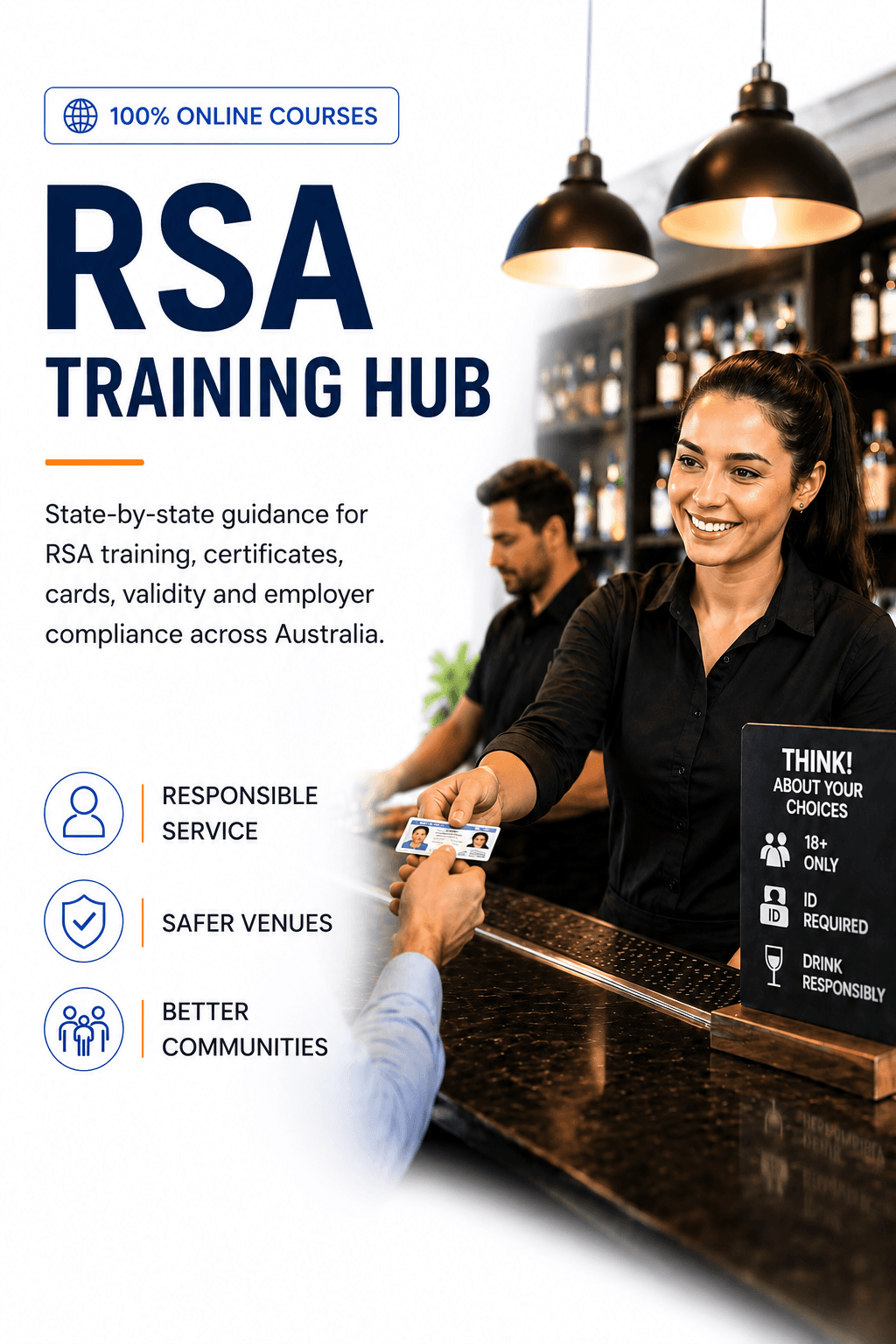
Responsible Service of Alcohol (RSA) training is a legal requirement for anyone who sells, serves or supplies alcohol in a licensed venue in Australia. Whether you work in a pub, bar, restaurant, hotel, bottle shop, nightclub, club, or at a licensed event, RSA certification is mandatory — and the consequences of working without it, or with an expired or non-compliant certificate, include personal fines and licence compliance action against your employer.
But RSA is not a single national pathway. The underlying training unit — SITHFAB021 (Provide Responsible Service of Alcohol) — is nationally recognised, but each state and territory administers RSA differently. New South Wales requires a competency card. Victoria now has a mandatory two-step process including the SHARPR module. Queensland relies on the Statement of Attainment. South Australia requires approved-provider delivery. Victoria, the ACT and the Northern Territory require refresher training every 3 years.
This RSA Training Hub has been created by Access All Areas Training (RTO 52312) to help hospitality workers, job seekers, employers and multi-site venue operators understand the correct RSA pathway for their state — before enrolling, before starting work, and before accepting a staff member's certificate as evidence.
AAAT delivers RSA in all 8 Australian states and territories. 200,000+ students trained. 4.7 stars from 1,931+ Google reviews. SITHFAB021 — same-day Statement of Attainment. Trusted by Dan Murphy's, BWS, Nando's and more.
Resource currency: RSA requirements, approved provider rules, card arrangements, refresher periods and recognition processes can change. Confirm current requirements with your state or territory liquor regulator before enrolling, starting work or accepting existing RSA as evidence. Last reviewed: June 2026.
What Is RSA and SITHFAB021?
What Is RSA?
RSA stands for Responsible Service of Alcohol. It is a training requirement that applies to anyone who sells, serves, or supplies alcohol in a licensed venue in Australia. The purpose of RSA training is to ensure that hospitality workers have the knowledge and skills to serve alcohol responsibly — recognising signs of intoxication, refusing service where required, managing difficult situations, supporting patrons to get home safely, and complying with the liquor laws of their state or territory.
What Is SITHFAB021?
SITHFAB021 — Provide Responsible Service of Alcohol is the nationally recognised unit of competency that underpins RSA training across most Australian states and territories. It describes the performance outcomes, skills and knowledge required to responsibly sell, serve or supply alcohol.
Completing SITHFAB021 produces a nationally recognised Statement of Attainment — issued by an ASQA-registered RTO such as AAAT (RTO 52312). However, the Statement of Attainment alone does not automatically satisfy every state's requirements. Some states require additional steps — a government-issued card, a free state module, or confirmation of approved provider status — before you can legally work.
RSA Covers
• Recognising signs of alcohol intoxication in patrons
• Legal obligations for the sale, supply and service of alcohol
• Refusing service to intoxicated, disorderly or underage patrons
• Checking identification and verifying age
• Strategies for preventing intoxication and managing difficult situations
• Harm minimisation — providing food and water, assisting patrons to travel safely
• Venue policies, licence conditions, and documentation obligations
• The consequences of non-compliance — fines, licence action, personal liability
RSA is Not the Same in Every State
This is the most important thing to understand about RSA in Australia. The national training unit is the same, but the administrative requirements — how the certificate is obtained, what additional steps are needed, how long it lasts, and how it is renewed — differ significantly between jurisdictions.
- NSW: Requires a physical and digital competency card issued by Liquor & Gaming NSW via Service NSW. The training course produces an interim certificate valid for 90 days — the card must be obtained within that period.
- Victoria: Two-step process from 1 December 2025 — complete an LCV-approved RSA course (SITHFAB021), then complete the mandatory SHARPR module through the LCV Learning Hub. Only after both steps does LCV issue the Victorian Certificate of Completion. Valid 3 years.
- Queensland: No separate RSA card — the Statement of Attainment from an ASQA-registered RTO is the evidence of RSA certification. No formal expiry.
- Western Australia: No separate card. Statement of Attainment is evidence. No formal expiry in WA — "RSA courses have no expiration date once completed" (LGIRS). 28-day window for new staff.
- South Australia: Must be completed through an approved provider (approved by the SA Commissioner / CBS from 1 November 2020). No separate card.
- Tasmania: RSA certificate required. New staff must be enrolled or undertaking RSA within the first 3 months of employment.
- Northern Territory: RSA required. Refresher every 3 years mandatory under NT legislation.
- ACT: Must be completed through ACT-approved training provider. Refresher framework applies approximately every 3 years.
The safest rule: choose RSA based on the state or territory where you plan to work, not just the first course you find online. AAAT delivers state-specific RSA with all required components for each jurisdiction.
RSA Training by State and Territory
Who Needs RSA in NSW?
Anyone who is engaged in the sale, service or supply of alcohol at a licensed venue in New South Wales is required to hold a current RSA endorsement on a NSW competency card. This includes bartenders, waitstaff, bottle shop attendants, restaurant staff serving alcohol, club staff, hotel staff, event staff, and any other person whose role involves alcohol service in a licensed setting.
The NSW RSA Process — Step by Step
NSW is the most administrative RSA pathway in Australia because it requires a government-issued physical and digital competency card, not just a training certificate. The full process is:
- Complete RSA training with a Liquor & Gaming NSW (L&GNSW) Approved Training Provider (ATP): AAAT (RTO 52312) is an L&GNSW-approved training provider. Complete the course online. $149 (includes the competency card fee paid by AAAT to L&GNSW on your behalf).
- Receive your interim certificate: On successful completion, AAAT issues your interim certificate. This allows you to work in NSW RSA-required roles immediately — for up to 90 days from the date of issue.
- Apply for your NSW RSA competency card at Service NSW: Within the 90-day interim certificate period, attend a Service NSW service centre in person. You cannot apply by mail or online. Bring: your interim certificate, plus 100 points of original identity documents (document types listed on your interim certificate). A photo is taken at Service NSW.
- Receive your competency card: Your photo competency card is mailed to your nominated address within approximately 5 weeks of submitting your application at Service NSW. You can access your digital competency card immediately via the Service NSW app (look up your CCH number).
Start work immediately: Your interim certificate allows you to work in NSW RSA roles from the day it is issued. You do not need to wait for the physical card. Apply for the card at Service NSW as soon as possible — do not leave it to the last days of the 90-day window.
NSW RSA Competency Card — Key Facts
- Card validity: 5 years from the date the interim certificate was issued (not from the card collection date)
- Physical and digital: Physical card mailed to your address + digital card accessible via the Service NSW app on iOS and Android
- Renewing before expiry: Complete L&GNSW online refresher training before your card expires. Do not repeat the full course — the refresher is the correct renewal pathway. L&GNSW sends reminders approximately 90 days before expiry.
- If your card has expired: If expired within 28 days, you may still renew via refresher training. If expired more than 28 days, you must complete the full RSA course again.
- Fine for working without a card: You can be personally fined for working in an RSA-required role without a valid interim certificate or competency card in NSW.
- Duplicate cards: A second ATP course during the same 5-year period does not produce a new card or extend expiry. If you have lost your card or need a replacement, use the L&GNSW competency card self-service portal.
NSW RSA Bridging Course — Interstate Workers
If you have completed RSA training in another state or territory and want to work in NSW, you may be eligible for the NSW RSA Bridging Course rather than a full new RSA course. This is an online course offered by L&GNSW that covers NSW-specific liquor law requirements.
- Eligible from VIC, ACT, NT: You must have a national RSA Statement of Attainment or RSA refresher certificate issued within the last 3 years.
- Eligible from QLD, WA, SA, TAS: You must have a national RSA Statement of Attainment issued within the last 5 years.
- After the bridging course: You receive an interim certificate and must attend Service NSW to apply for your NSW competency card — same process as above.
- Cross-border workers: If you permanently reside in another state but work temporarily in NSW, you can work on your valid interstate certificate without the bridging course — but you should still present it if asked by police or L&GNSW inspectors.
If you have previously held an NSW competency card, contact L&GNSW to have your existing details removed before visiting Service NSW to apply for a new card. Service NSW cannot remove your details in the centre.
Victoria RSA Has Changed — What You Need to Know (From 1 December 2025)
Important — mandatory from 1 December 2025: Victorian RSA is now a two-step process. You must complete both an LCV-approved RSA course AND the SHARPR module through the LCV Learning Hub before you can receive your Victorian Certificate of Completion. A Statement of Attainment alone is not sufficient to work in a Victorian licensed venue from this date.
The Victoria RSA Two-Step Process
- Step 1 — Complete an LCV-approved RSA course (SITHFAB021): AAAT is an LCV-approved training provider. Complete the AAAT Victoria RSA course online. The course covers SITHFAB021 and Victorian liquor licensing and compliance content. Duration: approximately 6 hours at your own pace. On successful completion, AAAT issues your Statement of Attainment and registers your details with LCV.
- Step 2 — Complete the SHARPR module via the LCV Learning Hub: After completing your course with AAAT, you will receive an email from LCV with instructions to create an account on the LCV Learning Hub (learninghub.liquor.vic.gov.au). The SHARPR module is free, takes approximately 60 minutes, and is completed entirely online through the government portal. LCV issues your Victorian Certificate of Completion after you finish the module.
What Is SHARPR?
SHARPR stands for Sexual Harassment and Assault: Recognise, Prevent and Respond. It is a mandatory training module introduced by Liquor Control Victoria as part of a commitment to creating safer environments in licensed venues for both staff and patrons. SHARPR covers how to recognise, prevent and respond to sexual harassment and assault incidents in a licensed venue context.
- Who delivers it: SHARPR is delivered exclusively through the LCV Learning Hub — a government portal at learninghub.liquor.vic.gov.au. It is not part of AAAT's course and cannot be purchased through AAAT.
- Cost: The SHARPR module is free. You only pay for your accredited RSA course with AAAT.
- Access: You receive access via an email from LCV after AAAT registers your completion. If you do not receive an email within 2 business days, contact AAAT first to confirm your details were submitted correctly.
- Account setup: Your LCV Learning Hub account must use the exact same name and date of birth that your training provider (AAAT) submitted to LCV. Typos or discrepancies cause login errors — contact LCV at contact@liquor.vic.gov.au if you encounter this.
Your Victorian Certificate of Completion
Once both steps are complete, LCV issues your Victorian Certificate of Completion — the document you must present to your employer to work in a Victorian licensed venue. Your Statement of Attainment from AAAT alone is not the document for Victorian venue purposes.
- Validity: 3 years from the date of issue
- Refresher at 3 years: RSA refresher training is required every 3 years. The refresher is also a two-step process from 1 December 2025 — complete an LCV-approved refresher course, then complete the SHARPR module again via the LCV Learning Hub. The LCV online refresher is free.
- Existing certificates (pre-December 2025): If your Victorian certificate was issued before 1 December 2025 and is still within its 3-year validity, you do not need to complete SHARPR until your next renewal. At that point, the full two-step process applies.
Interstate Workers Coming to Victoria
If you completed RSA training in another state and want to work in Victoria, you may be eligible for the LCV free online RSA Bridging Course — available at vic.gov.au/rsa-training. This course confirms you meet Victorian requirements and results in a Victorian Certificate of Completion. Eligibility depends on the currency of your existing RSA.
- 28-day window: If you are new to a Victorian licensed venue job, you must complete RSA within one month of first serving alcohol at the venue.
- Under 18: People under 18 can complete RSA training in Victoria but cannot serve alcohol until they turn 18.
What Victoria RSA Covers
The AAAT Victoria RSA course covers SITHFAB021 (nationally recognised) plus Victorian-specific content including:
• The Liquor Control Reform Act 1998 (Vic) and related regulations
• LCV-specific obligations for licensees and staff
• Refusing service and managing intoxicated patrons under Victorian law
• Identifying minors and acceptable ID in Victoria
• Harm minimisation strategies relevant to Victorian venues
• Victorian penalty and infringement framework
Who Needs RSA in Queensland?
Anyone engaged in the sale, service or supply of alcohol at a licensed venue in Queensland is required to hold RSA certification. The requirement is established under the Liquor Act 1992 (Qld) and administered by the Office of Liquor and Gaming Regulation (OLGR).
How Queensland RSA Works
Queensland is one of the simpler RSA pathways in Australia. Business Queensland confirms that Queensland does not issue a separate RSA card — the Statement of Attainment from an ASQA-registered RTO is the key evidence of RSA certification.
- Complete RSA online with AAAT: AAAT delivers SITHFAB021 online for Queensland. Cost: $59. Same-day Statement of Attainment on successful completion.
- Evidence: Your Statement of Attainment for SITHFAB021 is the document you present to your employer and, if required, to OLGR compliance officers.
- No government card required: Unlike NSW, Queensland does not require a separate government-issued card. Your training certificate is your proof of certification.
- No formal expiry: Queensland RSA does not have a formal legislated expiry period. However, employers may have their own policies, and workers who have not refreshed their RSA knowledge in several years should consider a refresher.
Employer Obligations in Queensland
Employers (licensees) in Queensland are responsible for ensuring staff who serve alcohol have completed RSA before doing so, or as soon as practicable after commencement. Keep a copy of each staff member's Statement of Attainment on file and check that it covers the correct unit (SITHFAB021 or the superseded SITHFAB002 if recently issued).
Who Needs RSA in Western Australia?
Under the Liquor Control Act 1988 (WA) and regulations administered by LGIRS (formerly DLGSC), any person engaged in the sale, supply or service of alcohol at a WA licensed venue is required to complete RSA training. This applies to all staff in roles involving direct alcohol service — bartenders, waitstaff, bottle shop attendants, supervisors, and managers.
How WA RSA Works
- Training unit: SITHFAB021 — Provide Responsible Service of Alcohol. Delivered by AAAT online. Cost: $59. Same-day Statement of Attainment on successful completion.
- Evidence: Your SITHFAB021 Statement of Attainment is your evidence of RSA certification in WA. No separate government card is required.
- No formal expiry in WA: LGIRS states that currently, in Western Australia only, RSA courses have no expiration date once completed. Your WA RSA certification does not expire under WA legislation.
- 28-day rule for new staff: Staff engaged in the sale, supply or service of liquor have 28 days from the date they commence employment or volunteering in that capacity to complete RSA. They must provide a copy of their training certificate to the employer as soon as practicable after completion.
28-day window: New staff in WA have 28 days from their first shift serving alcohol to complete RSA. AAAT recommends completing RSA before the first shift where possible — do not wait until day 27.
Training Register in WA
Under the Liquor Control Regulations 1989 (reg. 14AG(2)), licensees must maintain a training register recording employees and volunteers who have completed RSA, and retain copies of training certificates on the premises in a format available for inspection by authorised officers.
WA RSA and the Approved Manager Pathway
In WA, RSA is the foundation qualification for all staff who serve alcohol. If you are moving into a management or supervisory role — responsible for managing a licensed venue — you may also need to complete the WA Approved Manager course (MLPLCA001) and obtain an Approved Manager card from LGIRS. RSA alone does not authorise you to act as Approved Manager.
Who Needs RSA in South Australia?
Anyone who is engaged in the sale, service or supply of alcohol at a licensed venue in South Australia is required to hold RSA certification under the Liquor Licensing Act 1997 (SA), administered by Consumer and Business Services (CBS) SA.
SA Approved Provider Requirement — From 1 November 2020
Approved provider required: From 1 November 2020, all RTOs delivering RSA training in South Australia must be approved by the SA Commissioner (CBS SA). AAAT is approved to deliver RSA training in SA. When enrolling in any SA RSA course, confirm the provider's approval status before paying.
- Training unit: SITHFAB021 — Provide Responsible Service of Alcohol. Delivered by AAAT online. Cost: $59. Same-day Statement of Attainment.
- Evidence: Statement of Attainment from an approved RTO. No separate government card in SA.
- No formal expiry: SA does not legislate a formal RSA expiry period. Employers and licensees may have their own policies on refresher training.
- Local council enforcement: In SA, food and liquor compliance is often enforced at the local council level as well as through CBS SA. Confirm requirements with your specific council or employer.
Who Needs RSA in Tasmania?
Anyone serving alcohol in a licensed venue in Tasmania is required to hold an RSA certificate. This is a requirement under the Liquor Licensing Act 1990 (Tas) administered by Liquor and Gaming Tasmania.
How Tasmania RSA Works
- Training unit: SITHFAB021 — Provide Responsible Service of Alcohol. Delivered by AAAT online. Cost: $59. Same-day Statement of Attainment.
- Evidence: RSA certificate from an approved course. No separate government card in TAS.
- 3-month enrolment rule for new staff: Service Tasmania states that workers must have an RSA certificate to serve alcohol. If employed for less than 3 months, the worker must be enrolled in or undertaking an RSA course to be held within those first 3 months.
- Completing before starting: AAAT recommends completing RSA before the first shift where possible. The 3-month window is a maximum — not a standard for compliance.
Tasmania requirements can vary by licence type. Some types of licence in Tasmania may have specific RSA or area requirements. Confirm the requirements applying to your specific role and venue with Liquor and Gaming Tasmania at treasury.tas.gov.au.
Who Needs RSA in the Northern Territory?
RSA is required for any person engaged in the service of alcohol at a licensed venue in the Northern Territory. The requirement is administered by NT Licensing NT (part of the Department of Industry, Tourism and Trade) under the Liquor Act 2019 (NT).
How NT RSA Works
- Training unit: SITHFAB021 — Provide Responsible Service of Alcohol. Delivered by AAAT online. Cost: $59. Same-day Statement of Attainment.
- Evidence: Statement of Attainment from an ASQA-registered RTO. No separate government card in NT.
- Mandatory refresher every 3 years: NT Government guidance states that an RSA refresher course must be completed every 3 years. This is a legislative requirement under the NT liquor licensing framework.
- NT Refresh RSA: The NT Government operates a specific refresher platform at ntrefreshrsa.com for NT RSA refresher requirements. Check this site for current refresher options and timing.
3-year refresher is mandatory in NT: Unlike QLD or WA where RSA has no formal expiry, NT legislation requires refresher training every 3 years. Workers and employers in the NT must track RSA expiry dates and ensure refreshers are completed before expiry.
Who Needs RSA in the ACT?
RSA is required for people working in licensed venues in the ACT under the Liquor Act 2010 (ACT), administered by Access Canberra. All staff selling, serving or supplying alcohol must hold current RSA certification from an approved training provider.
How ACT RSA Works
- Approved provider required: Access Canberra maintains a list of RTOs approved to deliver RSA training in the ACT. AAAT is approved for the ACT RSA pathway. Confirm approval status on the Access Canberra approved RTO list before enrolling.
- Training unit: SITHFAB021 — Provide Responsible Service of Alcohol. Delivered by AAAT online. Cost: $59. Same-day Statement of Attainment.
- Evidence: Statement of Attainment from an ACT-approved provider. No separate government card in the ACT.
- Refresher requirement: ACT has a refresher framework that applies approximately every 3 years. AAAT offers an ACT RSA Refresher course. Confirm current ACT refresher timing with Access Canberra before relying on an older certificate.
- Full and refresher delivery: Not all providers are approved for both full RSA and refresher delivery in the ACT. Check the ACT approved provider list to confirm the provider you choose is approved for the relevant delivery type.
RSA Card, Certificate and Statement of Attainment
A Statement of Attainment (SOA) is a nationally recognised training document issued by an ASQA-registered RTO when a learner successfully completes one or more units of competency. For RSA, the unit is SITHFAB021 — Provide Responsible Service of Alcohol.
AAAT (RTO 52312) issues Statements of Attainment to all students who successfully complete the AAAT RSA course. The SOA is issued same-day in most states and includes the student's name, date of completion, the RTO's ASQA registration details, and the unit code.
- Used in: QLD, WA, SA (as evidence of RSA). Also used in NSW, VIC, TAS, NT, ACT as the training certificate — but these states require additional steps beyond the SOA.
- Not used alone in NSW: NSW requires the interim certificate (issued by the ATP at the end of training) and then the competency card from Service NSW. The generic SOA from AAAT is not the document for NSW competency card purposes — the interim certificate is.
- Not sufficient alone in VIC (from Dec 2025): The SOA must be followed by completion of the SHARPR module through the LCV Learning Hub, which results in the Victorian Certificate of Completion — the actual working document.
The NSW RSA Competency Card is a government-issued physical and digital card issued by Liquor & Gaming NSW (L&GNSW) via Service NSW. It is unique to New South Wales — no other state issues an equivalent card for RSA.
Format: Physical plastic card (similar to a driver's licence) with your photo, name, endorsements, card number and expiry date. Also available as a digital card in the Service NSW app.
- Validity: 5 years from the date the interim certificate was issued
- Required to work in NSW: You must be able to show your competency card (or a valid in-date interim certificate) if asked by an employer, police officer, or L&GNSW compliance officer. Fines apply for working without one.
- How to get it: Complete an L&GNSW-approved RSA course (AAAT), receive your interim certificate, then attend Service NSW in person with 100 points of ID and have your photo taken. Card mailed within approximately 5 weeks.
- Renewal: Complete L&GNSW online refresher training before expiry. Do not redo the full course — only the refresher extends the endorsement.
From 1 December 2025, the Victorian Certificate of Completion is issued by Liquor Control Victoria (LCV) after a worker completes both steps of the new two-step Victorian RSA process: the accredited RSA course (SITHFAB021) and the mandatory SHARPR module via the LCV Learning Hub.
- Validity: 3 years from the date of issue
- Issued by: Liquor Control Victoria — it is a government document, not an AAAT document
- Required to work in VIC: The Certificate of Completion is what you must present to your Victorian employer. Your AAAT Statement of Attainment alone is not the working document in Victoria.
- SHARPR certificate: The Certificate of Completion includes confirmation that SHARPR was completed. Both steps are combined into the single LCV document.
- Renewal: Complete LCV-approved RSA refresher training and SHARPR again via LCV Learning Hub every 3 years. LCV RSA online refresher is free.
NSW: Interim certificate (90 days) → then NSW RSA Competency Card (5 years) from Service NSW. Both are L&GNSW documents.
Do not confuse the AAAT Statement of Attainment with the NSW interim certificate — these are different documents.
Victoria: LCV Certificate of Completion (3 years) — issued only after both the SITHFAB021 course AND SHARPR module are completed. AAAT SOA is not the working document in VIC.
The LCV Certificate of Completion is what your Victorian employer needs.
Queensland: Statement of Attainment for SITHFAB021 from an ASQA-registered RTO. No card required. No formal expiry.
Western Australia: Statement of Attainment for SITHFAB021. No card required. No formal expiry under WA legislation.
South Australia: Statement of Attainment from an approved provider (approved by CBS SA from 1 November 2020). No card required.
Tasmania: RSA certificate from an approved course. New staff must be enrolled or undertaking within the first 3 months of employment.
Northern Territory: Statement of Attainment from an ASQA-registered RTO. 3-year refresher mandatory.
ACT: Statement of Attainment from an ACT-approved provider. Refresher approximately every 3 years.
RSA Guidance for Employers and Multi-Site Venues
For employers, RSA is not just a pre-employment requirement to tick off at induction. It is an ongoing legal obligation. The licensee of a venue is responsible for ensuring all staff in RSA-required roles hold current, valid RSA certification for the state in which they work — before or within the required period of commencing work.
What Employers Must Do
- Ensure all staff serving, selling or supplying alcohol hold current RSA certification before or within the required period of commencing work in that role
- Maintain a training register recording each staff member's RSA status, certificate type, issue date, and expiry or refresher date where applicable
- Keep a copy of each staff member's RSA certificate, card or Statement of Attainment on the premises in a format available for inspection
- In NSW: verify the interim certificate or competency card is current and has an RSA endorsement — not just that the person claims to have done RSA
- In Victoria (from Dec 2025): verify the Victorian Certificate of Completion — not just the SITHFAB021 Statement of Attainment
- In NT and VIC and ACT: track 3-year refresher dates and ensure renewal before expiry
- In WA: apply the 28-day rule — new staff must complete RSA within 28 days of commencing work in an alcohol service role
- In TAS: new staff must be enrolled in RSA within 3 months of commencing work in an alcohol service role
The Training Register — What to Record
- Staff name and role
- State or territory where the person works
- RSA evidence type (SOA, NSW competency card number and expiry, Victorian Certificate of Completion)
- Provider or RTO that issued the certificate (for AAAT: RTO 52312)
- Issue date
- Expiry or refresher due date where applicable (VIC: 3 years, NSW card: 5 years, NT: 3 years, ACT: ~3 years)
- Whether the staff member has management responsibilities requiring additional training (e.g. WA Approved Manager, VIC duty manager obligations)
- Copy of certificate or card filed in the register or on file
Multi-Site Venues — One RSA Rule Does Not Apply Everywhere
For hospitality groups with venues in multiple states, a common risk is applying the same RSA evidence check across all sites regardless of state. A VIC Certificate of Completion is not the right document for NSW compliance. A QLD Statement of Attainment is not the same as an NSW competency card. A staff member who transfers from Brisbane to Sydney needs to go through the NSW pathway.
- For each state you operate in, confirm the state-specific RSA evidence requirement
- For transfers between states, treat the transfer as a new RSA event — check whether the existing certificate satisfies the destination state's requirements or whether a bridging course or new enrolment is needed
- For seasonal or casual staff who move between states, maintain a record of where they last worked and what their current RSA evidence covers
Bulk enrolments and central tracking: AAAT provides central invoicing and completion tracking for hospitality groups and multi-site operators across all 8 states. Trusted by Dan Murphy's, BWS, Nando's, Boost Juice, Guzman Y Gomez and Moët Hennessy. Contact 1300 287 554 or employers@accessallareastraining.com.au.
RSA applies whenever alcohol is sold, served or supplied at a licensed venue. The specific role and venue type can affect the exact evidence required, but the general rule is that anyone in an alcohol service role needs RSA.
Bottle Shops and Liquor Stores
Staff selling alcohol at a bottle shop are engaged in the sale of alcohol — RSA is required. This applies to all staff in a serving or selling role, regardless of hours worked. In NSW, a current competency card is required. In VIC, the Victorian Certificate of Completion is required. In QLD and WA, the Statement of Attainment is sufficient.
Bars, Hotels, and Pubs
All staff serving alcohol in bars, pubs and hotels need RSA. This includes bar staff, floor staff, duty managers, and in some states, security staff. Venue managers may also need additional state-specific management qualifications — in WA this is the Approved Manager card (MLPLCA001). In VIC, duty managers and venue managers may have additional obligations under the Liquor Control Reform Act 1998.
Restaurants
Restaurants licensed to serve alcohol must ensure all staff involved in alcohol service hold current RSA for the state. This includes waitstaff who take alcohol orders and serve drinks, even if alcohol is not the primary focus of their role. In NSW, the competency card requirement applies.
Licensed Clubs
Licensed clubs — sporting clubs, RSL clubs, golf clubs, and similar — must ensure all staff involved in alcohol service hold RSA. In WA, club staff can complete either the SITHFAB021 (AAAT) or the Clubs WA RSA (Club Industry Training) pathway. In VIC, club staff need the full two-step Victorian RSA process from December 2025.
Events and Functions
Staff serving alcohol at licensed events — including festivals, functions, fundraisers, and occasional licence events — need RSA for the state where the event is held. For events held across multiple states, staff need state-appropriate RSA for each jurisdiction. For occasional licence events in WA, confirm whether an Approved Manager must be present under the licence conditions.
Under-18s and RSA
In most Australian states and territories, people under 18 can complete RSA training but cannot actually serve alcohol until they turn 18. Completing RSA training before turning 18 is sensible — it allows the person to start work in an RSA role immediately upon turning 18.
- Victoria: Under-18s can complete the RSA course and SHARPR module but cannot work in an alcohol service role until 18.
- NSW: Under-18s can complete the course and obtain the competency card, but cannot perform RSA-required duties until 18.
- All states: Confirm the specific age requirement with the relevant state liquor regulator before rostering under-18 staff in alcohol service roles.
One of the most common compliance risks for staff and employers is assuming that an RSA certificate from one state is automatically valid in every other state. This is not the case.
When Interstate RSA May Be Accepted
- QLD → WA, SA: A QLD Statement of Attainment (SITHFAB021) is generally accepted as evidence in WA and SA, as both states rely on the Statement of Attainment. Confirm with the employer.
- WA → QLD: WA Statement of Attainment is generally accepted in QLD for the same reason.
- Cross-border workers into NSW: Workers permanently based in another state who work temporarily in NSW can present their valid interstate RSA to employers and inspectors. If they permanently move to NSW, they must complete the bridging course and obtain the NSW competency card.
When Interstate RSA Is NOT Accepted
- Moving to NSW permanently: Must complete the L&GNSW RSA Bridging Course and obtain the NSW competency card.
- Working in Victoria (from any state): An interstate SOA allows completion of the free LCV RSA Bridging Course to obtain a Victorian Certificate of Completion — but the interstate certificate alone is not sufficient for Victorian employers from December 2025.
- SA: RSA must have been delivered by an SA-approved provider. An RSA from a provider not approved in SA may not satisfy SA requirements.
- ACT: Must be from an ACT-approved provider. A non-ACT RSA may require a refresher or bridging course.
- NT: Workers from other states must check the NT refresher requirements. A 5-year-old interstate RSA may not satisfy NT currency requirements.
When in doubt about whether your interstate RSA is accepted in a new state, contact the relevant state liquor regulator before starting work. AAAT can advise on which state pathway is required for your situation.
RSA and RSG — Responsible Service of Gambling
RSG stands for Responsible Service of Gambling (also called Responsible Conduct of Gambling or RCG, particularly in NSW). It is a separate training requirement from RSA that applies to people working in venues with gaming machines, TAB facilities, or other gambling services.
Who Needs RSG?
- Staff at venues with gaming machines — pokies or electronic gaming machines (EGMs)
- Staff at TAB betting venues and sports betting facilities
- Keno operators
- Staff at casinos in relevant states
RSG vs RSA — Not the Same
RSG and RSA are completely separate qualifications. Holding RSA does not mean you also hold RSG. If your role involves alcohol service and gambling supervision, you may need both. Many pub and club staff in states with gaming need both qualifications.
Which States Require RSG?
- NSW: RCG (Responsible Conduct of Gambling) is required for gaming machine work. The NSW RCG competency card process is similar to RSA — interim certificate then Service NSW for the card.
- QLD: RSG training required for gaming machine work under the Gaming Machine Act 1991 (Qld).
- WA: No gaming machines available at most venues. However, TAB and gaming is regulated. Check LGIRS for current WA gaming requirements.
- VIC, SA, TAS, NT, ACT: Each state/territory has its own framework for gaming staff training. Confirm requirements with the relevant regulator.
Frequently Asked Questions
Answer: No. RSA training uses the nationally recognised unit SITHFAB021 (Provide Responsible Service of Alcohol) across most states and territories, but the administrative requirements differ significantly. NSW requires a government-issued competency card via Service NSW. Victoria requires a two-step process from 1 December 2025 — an accredited RSA course plus the mandatory SHARPR module via the LCV Learning Hub. Queensland relies on the Statement of Attainment with no separate card. South Australia requires an approved provider. NT and ACT require refresher training every 3 years. Always check the specific requirements for the state or territory where you plan to work before enrolling.
Answer: SITHFAB021 — Provide Responsible Service of Alcohol is the nationally recognised unit of competency that underpins RSA training across Australia. It covers the skills and knowledge required to responsibly sell, serve or supply alcohol — including recognising intoxication, refusing service, checking ID, harm minimisation, and legal obligations. AAAT (RTO 52312) delivers SITHFAB021 online in all 8 states and territories.
Answer: Yes. NSW is the only Australian state that issues a physical and digital RSA competency card. The process is: complete an L&GNSW-approved RSA course (AAAT delivers this), receive your interim certificate (valid for 90 days), then attend a Service NSW centre in person with 100 points of ID to apply for your card. Your photo is taken at Service NSW. The card is mailed to you within approximately 5 weeks. The card is valid for 5 years. Fines apply for working in an RSA-required role without a valid interim certificate or competency card.
Answer: SHARPR stands for Sexual Harassment and Assault: Recognise, Prevent and Respond. It is a free, mandatory online training module introduced by Liquor Control Victoria (LCV) as part of Victoria's RSA requirements from 1 December 2025. After completing your AAAT RSA course, you receive an email from LCV with access to complete the SHARPR module on the LCV Learning Hub (learninghub.liquor.vic.gov.au). The module takes approximately 60 minutes. Only after completing both the accredited RSA course AND the SHARPR module does LCV issue your Victorian Certificate of Completion — which is what you must present to your Victorian employer.
Answer: Yes. Victorian RSA is valid for 3 years from the date of issue. A refresher must be completed before the certificate expires. From 1 December 2025, the refresher is also a two-step process — an LCV-approved RSA refresher course followed by the SHARPR module again via the LCV Learning Hub. The LCV online RSA Refresher is available for free at learninghub.liquor.vic.gov.au.
Answer: No. Business Queensland confirms that Queensland does not issue a separate RSA card. Your Statement of Attainment for SITHFAB021 from an ASQA-registered RTO (such as AAAT) is the evidence of RSA certification in Queensland. There is no formal expiry period for Queensland RSA under the Liquor Act 1992 (Qld), though employers may have their own refresher policies.
Answer: LGIRS states that currently, in Western Australia only, RSA courses have no expiration date once completed. Your WA RSA certification does not formally expire under WA legislation. However, WA has a 28-day rule for new staff — anyone commencing employment or volunteering in a role involving the sale, supply or service of liquor must complete RSA within 28 days. Best practice is to complete RSA before starting work rather than using the full 28-day window.
Answer: Yes. NT Government guidance states that an RSA refresher course must be completed every 3 years. This is a legislative requirement under the NT liquor licensing framework. Workers and employers in the NT must track RSA completion dates and ensure refresher training is completed before the 3-year mark. The NT Government operates a specific refresher platform at ntrefreshrsa.com.
Answer: Sometimes, but not automatically in every situation. RSA recognition across states can depend on the state you are moving to, the type of certificate you hold, the provider who issued it, the issue date, and whether the certificate is still current. For NSW: interstate workers can use a valid interstate certificate temporarily, but permanent NSW residents must complete the L&GNSW RSA Bridging Course and obtain the NSW competency card. For Victoria: an interstate SOA can be used to complete the free LCV RSA Bridging Course, resulting in a Victorian Certificate of Completion. For QLD and WA: interstate Statements of Attainment (SITHFAB021) are generally accepted. Always check with the destination state's liquor regulator before relying on interstate RSA evidence.
Answer: In most cases, yes. Bottle shop work involves the sale and supply of alcohol — RSA is required for staff in selling roles in all states and territories. In NSW, the competency card is required. In VIC (from December 2025), the Victorian Certificate of Completion is required. In QLD and WA, the Statement of Attainment is sufficient. Confirm the specific requirement with your employer and state regulator.
Answer: Employers should not just ask "do you have RSA?" — they should check:
- What type of evidence the person holds (SOA, interim certificate, NSW competency card, Victorian Certificate of Completion)
- Whether it was issued in the correct state for their workplace
- The issue date — and whether it is still current (VIC: 3 years, NSW card: 5 years, NT: 3 years)
- The name of the provider — confirm it is ASQA-registered and, where required, state-approved
- Whether the unit code is SITHFAB021 (or the superseded SITHFAB002 for older certificates)
- Whether the person has management-level responsibilities requiring additional training (WA Approved Manager, etc.)
Answer: No. RSA (SITHFAB021) certifies that a person can responsibly serve alcohol. WA Approved Manager training (MLPLCA001) certifies that a person can manage a licensed venue in Western Australia. Both may be required for a WA venue manager — RSA for the alcohol service aspect and the Approved Manager card for the management appointment. RSA alone does not qualify you to be formally appointed as a WA Approved Manager.
Answer: The NSW RSA Bridging Course is an online course offered by L&GNSW for interstate workers who hold a valid RSA from another state and want to work in NSW. It covers NSW-specific liquor law requirements and, on completion, produces an interim certificate for the NSW competency card process. Eligibility: from VIC, ACT, NT — RSA must be issued within the last 3 years. From QLD, WA, SA, TAS — RSA must be issued within the last 5 years. After the bridging course, you attend Service NSW in person to apply for the NSW competency card. Contact L&GNSW or visit nsw.gov.au for current bridging course details.
Answer: Not necessarily the full course. If you have a valid interstate RSA (SITHFAB021 Statement of Attainment), you may be able to complete the free LCV RSA Bridging Course at vic.gov.au/rsa-training to obtain a Victorian Certificate of Completion. The bridging course recognises your existing national qualification and ensures you meet Victorian-specific requirements. From 1 December 2025, you also need to complete the SHARPR module via the LCV Learning Hub as part of this process. Contact LCV directly to confirm your eligibility and the current bridging process.
Answer: Completion time varies by state — VIC takes approximately 6 hours, other states typically 3–4 hours at a self-paced rate. All AAAT RSA courses are self-paced and available 24/7 on any device. You can pause and resume at any time. For most states, your Statement of Attainment is issued same-day on successful completion. For NSW, your interim certificate is issued by AAAT same-day (or next business day) on successful completion and assessment marking. For VIC, your LCV Certificate of Completion is issued after you complete the free SHARPR module via the LCV Learning Hub — this is a separate step after the AAAT course.
Answer: Yes — in most Australian states, people under 18 can complete RSA training. However, they cannot actually serve alcohol in a licensed venue until they turn 18. The ability to serve alcohol is a separate legal requirement from completing the training. Completing RSA training before turning 18 is sensible — it means the person can start working in RSA-required roles immediately when they turn 18. Confirm the specific age requirements with your state liquor regulator.
Answer: Working in an RSA-required role without current RSA certification can result in: • Personal fines (NSW: specific fines apply for working without a valid competency card) • The licensee facing compliance action — including infringement notices, licence condition changes, or escalated enforcement • The venue's licence being placed under review • Increased personal liability if an alcohol-related incident occurs The specific penalties vary by state. In NSW, fines are a known outcome for working without a card. In all states, it is a breach of the venue's licence conditions. Complete RSA before starting work — same-day certification is available through AAAT in most states.
Answer: It depends on the state: • QLD and WA: no formal expiry, so technically still valid under legislation, but employers may require a refresher and your knowledge may be out of date. • NSW: if your competency card has expired (5 years from interim certificate date), you need to renew. If the card expired within 28 days, you can still renew via refresher. If expired longer than 28 days, you must redo the full course. • VIC: if your certificate is more than 3 years old, it is expired — you need to complete a new RSA course and SHARPR module. • NT and ACT: 3-year refresher required — a 2018 certificate is well past the refresher point. In any case, even where legislation does not formally expire your RSA, your knowledge of current liquor laws, venue obligations and responsible service practices will be significantly out of date. A refresher is strongly recommended.
Answer: AAAT (RTO 52312) is ASQA-registered and delivers SITHFAB021 (Provide Responsible Service of Alcohol) for all 8 Australian states and territories. For states where the Statement of Attainment is the primary evidence (QLD, WA), AAAT's certificate is directly accepted. For NSW, AAAT is an L&GNSW-approved training provider and issues the NSW interim certificate as part of the course — the competency card is then obtained from Service NSW. For VIC, AAAT is an LCV-approved provider — the AAAT course leads to the free SHARPR module via LCV and then the Victorian Certificate of Completion. For SA and ACT, AAAT is approved by the relevant authorities. AAAT can advise on the specific requirements for your state.
Answer: RSA training is designed to give hospitality workers the knowledge and practical skills to serve alcohol responsibly and safely. It is not simply a certificate process — the training is intended to produce genuine capability in managing alcohol service. Content typically covered: • Recognising signs of alcohol intoxication — mild, moderate and severe • Legal obligations for the sale, supply and service of alcohol in your state • Refusing service — how to do it safely and what the consequences of not doing it are • Checking and verifying age — acceptable ID, what to do when uncertain • Managing difficult and aggressive customers • Harm minimisation — providing food and water, arranging safe transport • Venue policies and licence conditions • Consequences of non-compliance — fines, prosecution, licence action • State-specific requirements for your jurisdiction
Official References
All compliance information in this hub is sourced from official government and regulator guidance. Requirements can change — confirm current requirements with the relevant regulator before enrolling, starting work, or accepting RSA evidence.
National
New South Wales
Service NSW — Apply for an RSA competency card: In-person application process
NSW RSA Bridging Course: For interstate workers coming to NSW
Victoria
Queensland
Western Australia
South Australia
Tasmania
Service Tasmania — Responsible serving of alcohol certificate: TAS RSA requirements
Liquor and Gaming Tasmania — RSA course: Additional TAS guidance
Northern Territory
NT Government — Responsible service of alcohol: NT RSA requirements, 3-year refresher
NT Refresh RSA: NT refresher platform
Australian Capital Territory
Disclaimer: Access All Areas Training (RTO 52312) delivers RSA online in all 8 Australian states and territories. State-specific course content, correct approved provider status, same-day Statement of Attainment in most states. 200,000+ students trained. 4.7 stars from 1,931+ verified Google reviews.
NSW RSA Online (incl. competency card)
Victoria RSA Online (incl. SHARPR process)
This RSA Training Hub is general information and training guidance only. It is not legal or regulatory advice. RSA requirements, approved provider rules, competency card arrangements, refresher periods, bridging courses and recognition processes may change and can vary by state or territory, licence type and worker role. In particular, Victorian RSA requirements changed significantly from 1 December 2025 with the introduction of the mandatory SHARPR module and LCV Learning Hub two-step process. Students and employers should confirm current requirements with the relevant state or territory liquor regulator before enrolling, relying on existing RSA evidence or making compliance decisions. AAAT updates this page regularly but cannot guarantee all information reflects the most current regulatory position at the time of reading. Last reviewed: June 2026. Compliance verified against: LCV Learning Hub guidance (VIC), L&GNSW competency card guidance (NSW), Business Queensland (QLD), LGIRS mandatory training guidance (WA), CBS SA (SA), Service Tasmania (TAS), NT Government (NT), Access Canberra (ACT).