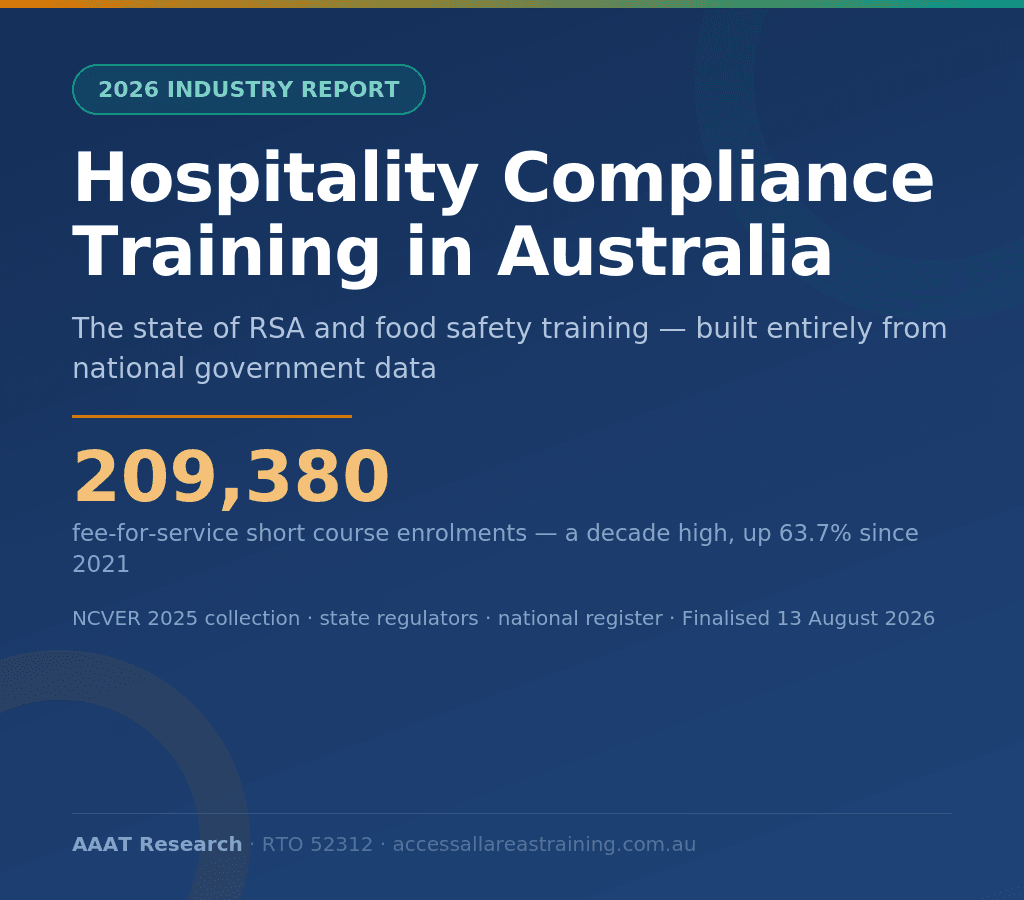
2026 Industry Report
Published by Access All Areas Training Pty Ltd (ACN 144 789 784) · RTO 52312 · Finalised 13 August 2026
Every figure in this report is drawn from public national datasets — principally the National Centre for Vocational Education Research (NCVER) Total VET Students and Courses 2025 release, published 22 July 2026 — and is individually attributed. Regulatory facts are cited to the responsible state regulators. This report examines what the new national data means for hospitality compliance training. AAAT internal data is not used.
Key Findings
- RSA enrolment recording shifted in 2025: stand-alone subject enrolments fell 43,480 while skill-set-recorded enrolments rose sharply — a movement NCVER attributes to a shift between delivery types rather than increased participation, and one most plausibly reflecting how providers classify and report the same training: the skill set contains only the RSA unit itself.
- Compliance is the engine of the short-course market: fee-for-service short course enrolments hit a decade-high 209,380, up 63.7% since 2021, dominated by RSA, first aid and workplace safety.
- Short, targeted training now dominates: importantly, we find students in full qualifications falling while short-course and stand-alone-subject participation rises — Australians increasingly train to gain the certification they need for work.
- Hospitality holds two of the nation’s top-ten compliance subjects: RSA (5th, 247,385 enrolments) and food safety hygiene (10th, 77,385).
- States are adding regulatory layers: a nationally accredited certificate is no longer sufficient on its own in every jurisdiction — Victoria, NSW and Tasmania each operate approved-provider or additional-content requirements on top of the national RSA unit and, in NSW, the NSW Food Authority operates the same approval model for Food Safety Supervisor training.
1. The RSA Numbers — What Moved in 2025, Read Carefully
The most eye-catching movement in the new national data needs the most careful reading: enrolments recorded against the stand-alone RSA unit fell sharply while enrolments recorded against the RSA skill set rose sharply — and the most plausible explanation is less dramatic than it first appears.
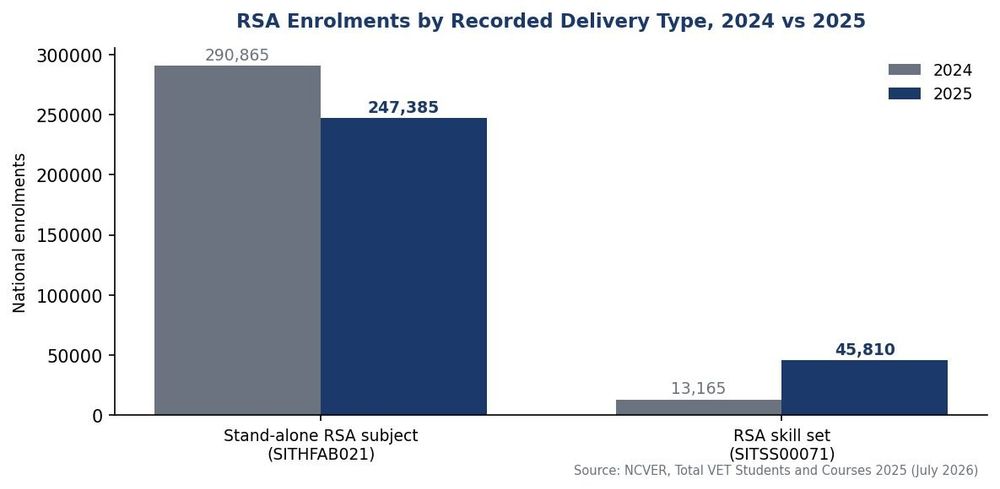
In 2025, enrolments recorded against the stand-alone subject Provide Responsible Service of Alcohol (SITHFAB021) fell by 43,480 — from 290,865 to 247,385 — while enrolments recorded against the Responsible Service of Alcohol skill set (SITSS00071) rose from 13,165 to 45,810. NCVER’s own analysis is direct: the movement “reflects a move from stand-alone subjects to skill set enrolments… rather than an overall increase in participation.”
What the movement most likely is
SITSS00071 is a single-unit skill set — its only unit is the RSA unit itself. The most plausible reading of the movement is therefore a change in how providers classify and report identical training, rather than a change in what students actually do: the same RSA course, recorded under a different delivery type. For workers, nothing changes — RSA remains a short, sharp certification — and read across both recording categories, national RSA training activity was broadly stable year on year. RSA remains among the country’s largest compliance subjects, with the stand-alone unit alone recording 247,385 enrolments in 2025.
2. The Compliance Economy — the Macro Picture
The hospitality story sits inside a larger national trend. Total VET participation reached 5,142,685 students in 2025 — a domestic participation rate of 26.4% on NCVER’s measure — but the composition of that training is changing sharply. Qualifications are the system’s deep-skill products — multi-unit, months or years long, the foundation on which careers are built — and students in them fell 5.2% to 1,982,745. Short courses and stand-alone subjects are the just-in-time products — hours to often a single day long, generally compliance-focussed, completed to gain the certification people need for work — and they grew: short-course students up 3.5% to 228,395, stand-alone-subject students up 1.7% to 3,656,585.
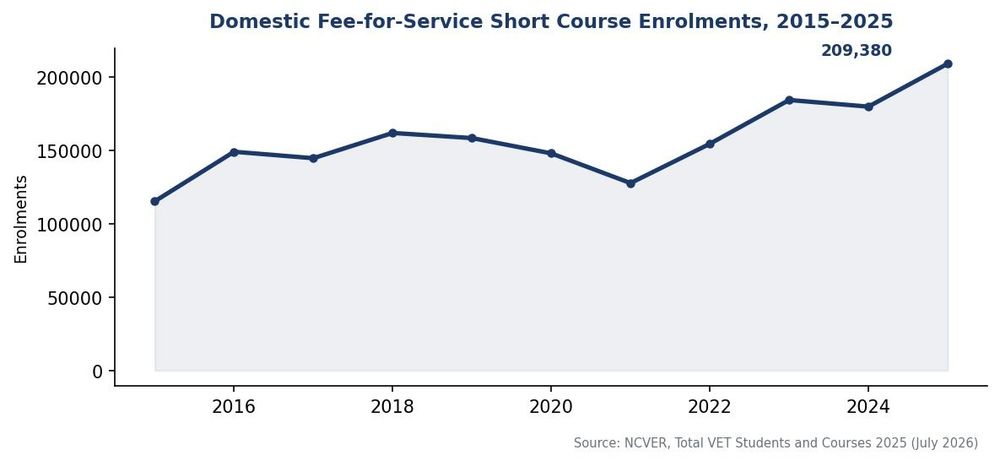
Domestic fee-for-service short course enrolments — the segment where hospitality compliance training lives — reached 209,380 in 2025, the highest level on record and 63.7% above 2021. NCVER describes this market plainly: fee-for-service short courses are “predominantly focused on workplace compliance and regulatory requirements, such as responsible service of alcohol, first aid, and workplace safety.” Stand-alone subject enrolments tell the same story at larger scale: 9.2 million enrolments in 2025 (+3.0%), up 162.4% in the fee-for-service market since 2015, with resuscitation, first aid and emergency life support alone accounting for 51.9% of the total [1].
Completions confirm the momentum: fee-for-service short course completions grew 32.7% in a single year, and training package skill set completions grew 67.6% [1]. Australians are not abandoning training — they are choosing shorter, targeted, job-ready formats. The just-in-time compliance model is now the dominant way Australia’s service workforce trains.
3. Where Hospitality Sits in the National Compliance Picture
Two hospitality units rank among the nation’s top ten stand-alone subjects: Responsible Service of Alcohol (5th) and Use Hygienic Practices for Food Safety (10th). The table below shows the full national top ten with year-on-year movement.
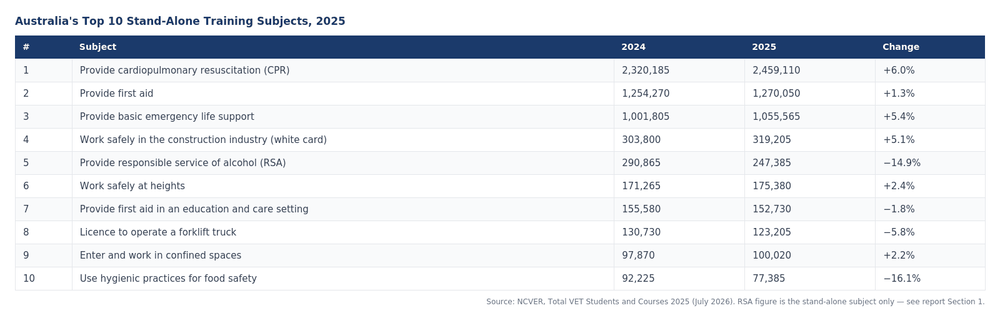
Percentage changes computed from NCVER published figures [1]. The RSA decline in this table is the stand-alone unit only — read alongside the skill-set-recorded enrolments in Section 1, it reflects a recording shift between delivery types rather than falling demand. The food safety movement is examined in Section 4.
4. The Food Safety Picture — After the 3.2.2A Wave
Food safety Standard 3.2.2A [7], which commenced on 8 December 2023, required most Australian food businesses to formally train food handlers and — for affected businesses as defined under the Standard — to appoint a certified Food Safety Supervisor per premises. The 2025 enrolment figures warrant an honest read against that backdrop.
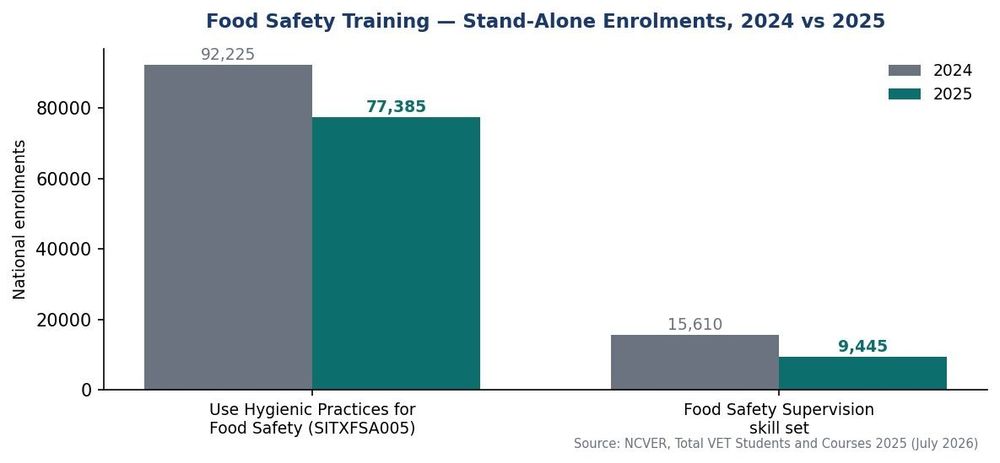
Stand-alone hygiene unit enrolments declined 16.1% from 92,225 to 77,385, and Food Safety Supervision skill set enrolments fell from 15,610 to 9,445. Two dynamics are consistent with these figures: the initial compliance catch-up wave of 2023–24 — when businesses rushed to meet the new standard — normalising; and food safety training migrating into packaged and qualification delivery, the same structural pattern NCVER identifies for RSA. Food safety training nonetheless remains a top-ten national compliance subject, and its regulatory driver is permanent: 3.2.2A obligations recur as new food businesses open and food-handling staff change.
5. The Regulatory Landscape — What Drives Demand
Hospitality compliance training demand is regulator-made. The obligations below — each cited to the responsible authority — are the permanent engines of the enrolment volumes in this report.
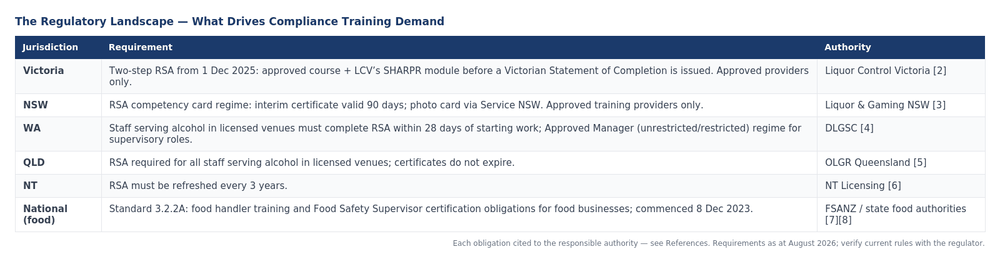
The direction of regulation is uniform: more verification, more approved-provider regimes, more structured delivery. Victoria’s SHARPR change is the clearest case — it concentrates delivery among LCV-approved providers, adds a mandatory second step for every Victorian worker, and arrived one month before the peak summer hiring season. The 2026 NCVER collection (published mid-2027) will show its full first-year effect; the national skill-set migration already visible in the 2025 data suggests the structural shift was underway before the mandate landed.
6. Outlook — What to Watch in 2026–27
- The Victorian first-year effect: the 2026 collection will quantify how the SHARPR two-step process changed Victorian RSA volumes and provider share.
- Recording and classification: whether the movement between stand-alone and skill-set recording stabilises in the 2026 collection will clarify how much reflects delivery change versus provider reporting practice.
- Food safety’s second wave: 3.2.2A obligations recur as new businesses open and food-handling staff change; enrolment stabilisation above pre-standard levels is the test of the 2026 data.
- Compliance’s share of VET: short-course and stand-alone growth against declining qualifications is the defining trend of the national training market — hospitality sits at its centre.
Methodology & Sources:
Enrolment and completion figures: NCVER, Total VET Students and Courses 2025 (published 22 July 2026), © Commonwealth of Australia — national figures for SITHFAB021, SITSS00071, SITXFSA005, the Food Safety Supervision skill set, top-ten subject and short-course tables, short course and stand-alone subject series, and completions. Attribution as required: NCVER 2026, Total VET students and courses 2025, NCVER, Adelaide. Percentage changes in tables are computed from the published figures. Regulatory facts: Liquor Control Victoria (two-step RSA process and approved-provider requirement, effective 1 December 2025); Liquor & Gaming NSW (competency card regime); WA Department of Local Government, Sport and Cultural Industries (28-day rule; Approved Manager regime); OLGR Queensland; NT Licensing (3-year refresher); Food Standards Australia New Zealand (Standard 3.2.2A, commenced 8 December 2023); NSW Food Authority (approved-provider requirement for Food Safety Supervisor certification).
Limitations: delivery-type figures (stand-alone subjects, skill sets, qualifications) are reported by NCVER as separate series and are not summed in this report; movements between delivery types can reflect provider reporting classification as well as changes in delivery. State-level subject breakdowns are available through NCVER’s DataBuilder and may be examined in a future edition. Where a figure could not be publicly sourced, it has been omitted rather than estimated.
Report prepared by Access All Areas Training (RTO 52312), an ASQA-registered training organisation delivering RSA, food safety and WA Approved Manager training Australia-wide since 2010. Registration verifiable at training.gov.au [9].
References
[1] NCVER 2026, Total VET students and courses 2025, NCVER, Adelaide. © Commonwealth of Australia. Published 22 July 2026. https://www.ncver.edu.au/research-and-statistics/publications/all-publications/total-vet-students-and-courses-2025 (accessed 6 August 2026).
[2] Liquor Control Victoria — Responsible Service of Alcohol requirements, including the two-step certification process effective 1 December 2025 and the approved training provider list. vic.gov.au (Liquor Control Victoria).
[3] Liquor & Gaming NSW — RSA competency card scheme, interim certificate arrangements and approved training providers. liquorandgaming.nsw.gov.au.
[4] Department of Local Government, Sport and Cultural Industries (WA) — mandatory RSA training requirements for staff in licensed venues and the Approved Manager scheme. dlgsc.wa.gov.au.
[5] Office of Liquor and Gaming Regulation (Queensland) — RSA training requirements for licensed venues. business.qld.gov.au.
[6] Northern Territory Government (Licensing NT) — RSA renewal requirements. nt.gov.au.
[7] Food Standards Australia New Zealand — Standard 3.2.2A (Food Safety Management Tools), commenced 8 December 2023. foodstandards.gov.au.
[8] NSW Food Authority — Food Safety Supervisor certification and approved training provider requirements. foodauthority.nsw.gov.au.
[9] Australian Government — training.gov.au, national register of RTOs. Access All Areas Training Pty Ltd, RTO 52312: https://training.gov.au/Organisation/Details/52312 (accessed 6 August 2026).
Copyright, Disclaimer & Permitted Use
© 2026 Access All Areas Training Pty Ltd (ACN 144 789 784). All rights reserved, other than third-party material. NCVER data is © Commonwealth of Australia and is reproduced in this report with attribution in accordance with NCVER’s copyright and licensing terms; all NCVER figures remain the property of the Commonwealth.
This report is provided for general information purposes only. It does not constitute legal, financial or professional advice, and it is not a substitute for advice specific to your circumstances. Regulatory and licensing requirements change and vary by jurisdiction and business type; readers must verify current requirements directly with the relevant regulator before acting. While care has been taken to ensure figures are accurately reproduced from the cited public sources as at the date of publication, Access All Areas Training Pty Ltd and its contributors make no warranty as to completeness or continued accuracy, and to the maximum extent permitted by law accept no liability for any loss arising from reliance on this report. Analysis and interpretation, where offered, are clearly framed as such and represent the publisher’s views.
Permitted use: this report may be quoted, cited and shared with attribution — “Access All Areas Training (2026), Hospitality Compliance Training in Australia: 2026 Industry Report” — provided figures are not altered and quotations are not presented in a misleading context. Media enquiries: accessallareastraining.com.au.