The Two-Gate Market








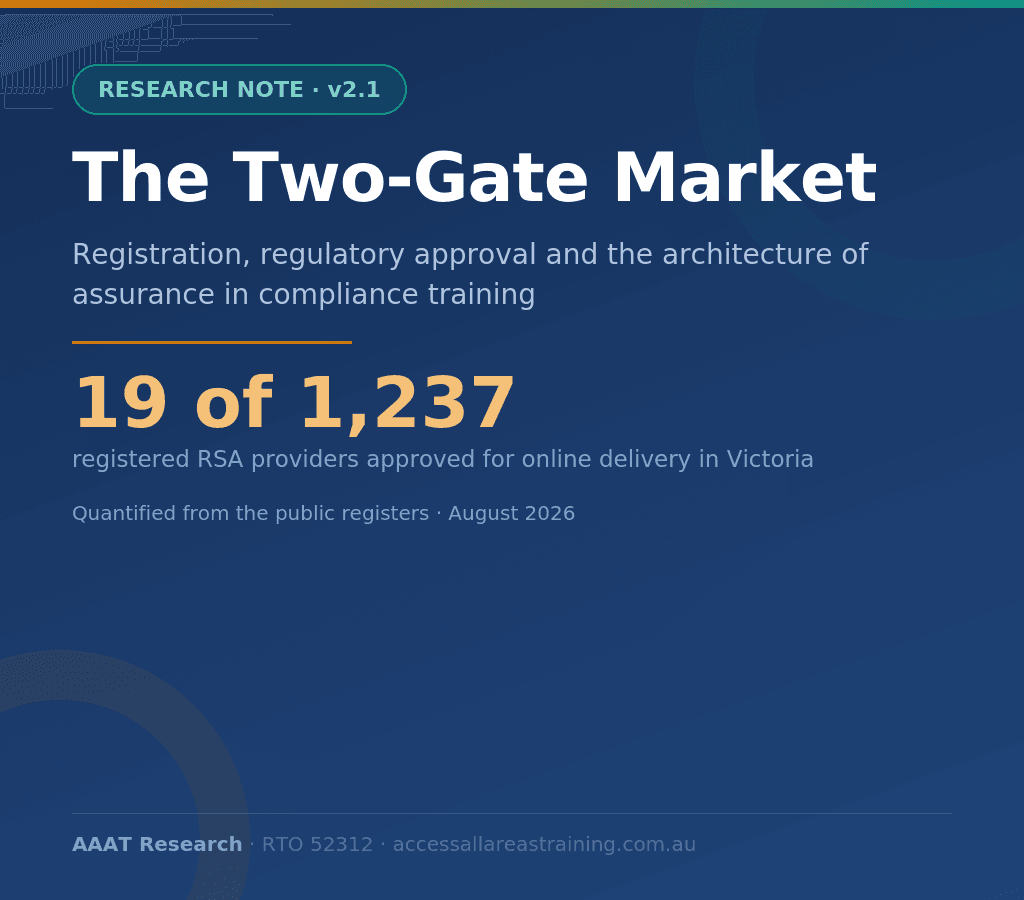
Registration, Regulatory Approval and the Architecture of Assurance in Hospitality Compliance Training
Research Note · Version 2.1 · Finalised 13 August 2026 · Register data as at 6 August 2026 · Victorian list re-verified 13 August 2026 · Access All Areas Training (RTO 52312)
Abstract:
Australian hospitality compliance training operates through a two-gate architecture: national RTO registration determines who may deliver nationally accredited courses such as RSA (SITHFAB021 — Provide Responsible Service of Alcohol), whilst a growing layer of state regulatory approval determines what additional content is required, and which providers a state accepts, for state-based certification. Using register and regulator data collected on 6 August 2026, this note quantifies both layers. The national delivery pool for the RSA unit stands at 1,237 registered providers; Victoria accepts 19 of them for online delivery, and New South Wales and Tasmania maintain approval regimes of their own. In our view this reflects a durable feature of the market, not an anomaly: state approval is a regulatory assurance mechanism — the means by which a liquor or food regulator satisfies itself about who delivers a regulatory credential and how — and we are likely to see more rather than less state-based intervention in the delivery of nationally accredited training.
Key Findings
- The national delivery layer is broad: 1,237 RTOs are registered to deliver the RSA unit (SITHFAB021); 1,385 for the food safety hygiene unit (SITXFSA005); 1,167 for safe food handling (SITXFSA006) [1].
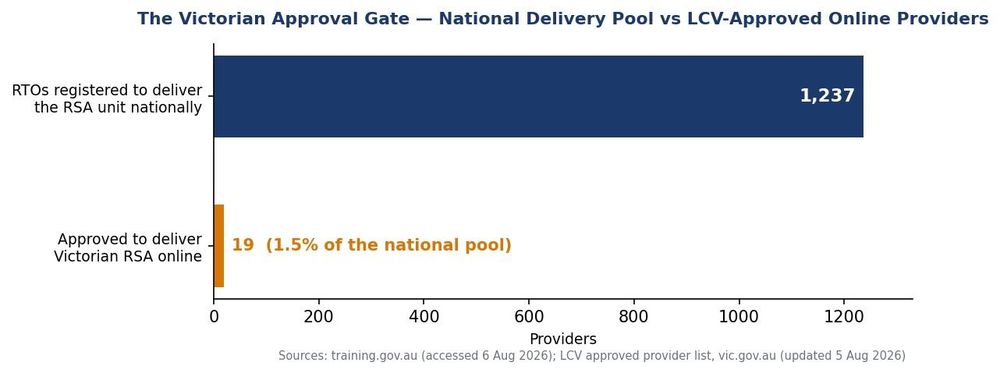
- The state approval layer is deliberately narrow: Victoria’s approved online RSA provider list contains 19 providers — 1.5% of the national delivery pool for the same underlying unit — a scale that keeps oversight within the regulator’s capacity to provide meaningful assurance [2].
- Approval is assurance, not restriction: state approval of providers is not intended to unnecessarily restrict competition — it is a regulatory assurance mechanism, allowing the regulator to ensure jurisdiction-specific requirements are met and providers remain subject to effective ongoing oversight [2].
- The architecture is spreading: New South Wales operates parallel approved-provider regimes for alcohol (L&GNSW) and food (NSW Food Authority), and Tasmania’s Commissioner approves RTOs to deliver RSA with Tasmanian content [5][7]. In our view, the direction is toward more state-based involvement in nationally accredited training, not less.
1. Framework and Method
This note treats hospitality compliance training as a regulated market with two distinct gates. Gate one is national: registration on training.gov.au and scope approval for specific units of competency, administered under the ASQA framework. Gate two is jurisdictional: state regulator approval regimes that determine whether a given provider’s delivery satisfies the state’s legal requirement — irrespective of the provider’s national registration status.
Data was collected on 6 August 2026 from primary sources only: provider delivery counts from the national register’s per-unit “Find RTOs” records [1]; Victoria’s approved provider list from Liquor Control Victoria’s published page, last updated 5 August 2026 [2]; regulatory requirements from the responsible state regulators [4][5][6]. Counts are the record totals returned by the register’s per-unit “Find RTOs” search, reflect the register at the date accessed, and change as RTO scopes change. No provider survey or private data was used.
2. Gate One — The National Delivery Layer
At the national layer, hospitality compliance is among the most contested delivery markets in Australian VET: more than a thousand registered providers hold scope for each core unit. Combined with NCVER’s enrolment data — 247,385 stand-alone RSA subject enrolments in 2025 [3] — the picture at gate one is of a large, competitive, commoditising market. Gate one, however, no longer determines who can actually serve a compliant certificate in the jurisdictions where most hospitality work happens.
3. Gate Two — The Victorian Case
Victoria’s regime, effective 1 December 2025, is the clearest expression of the second gate [2][4]. A Victorian RSA now requires an LCV-approved course plus the regulator’s own SHARPR module before a Victorian Certificate of Completion is issued. Delivery of the course component is restricted to providers on LCV’s published list.
The quantitative effect: of 1,237 nationally registered RSA providers [1], 19 appear on the approved online delivery list — 1.5% of the pool [2]. The regulator’s page pairs the list with an explicit negative signal, naming providers whose courses are not approved and advising that a non-approved course yields a Statement of Attainment that does not permit alcohol supply in Victorian licensed venues. The list itself is actively maintained — its most recent update preceded this note’s data collection by one day.
The approval process itself illustrates what gate two involves. LCV’s approval includes reviewing the provider’s course materials and assessments, requiring amendments where necessary, and entering into an agreement with the provider; LCV also registers trainers, provides approved providers with access to its certificate database and training materials, and communicates regulatory changes through ongoing updates [2][4]. This is a managed delivery partnership, not a one-off accreditation.
New South Wales runs the same architecture across two regimes. Only Liquor & Gaming NSW Approved Training Providers may deliver the mandatory RSA training that leads to a NSW competency card — the regulator’s own guidance warns that courses from non-approved providers will not yield the card required to work [5]. In food safety, the NSW Food Authority maintains an approved list of RTOs for Food Safety Supervisor training (SITSS00069): only approved RTOs can issue the required NSW Food Safety Supervisor certificate, and a Statement of Attainment from an unapproved provider does not itself authorise someone as a Food Safety Supervisor [6]. Provider counts for the NSW registers are being confirmed against the live search tools for the published edition and will be inserted alongside the Victorian figure.
4. Why Is This Happening? — Registration versus Regulatory Approval
In our view, the distinction lies between RTO registration and regulatory approval. Being an RTO demonstrates that an organisation is authorised to deliver nationally recognised training. It doesn’t necessarily establish that the liquor regulator in that state should accept the organisation as a trusted delivery partner for a regulatory credential. The rationale for additional requirements and a limited number of approved providers at state level includes the following.
RSA is a regulatory intervention, not simply a vocational qualification
The purpose isn’t merely to demonstrate occupational competency. RSA is one of the mechanisms by which a jurisdiction seeks to reduce alcohol-related harm and enforce liquor laws. That gives the state a legitimate interest in who delivers the training and how, rather than simply accepting every provider authorised to deliver the national unit. There are good arguments for separate state approvals: liquor legislation, enforcement practices, harm-minimisation priorities and regulatory expectations differ between jurisdictions, and the state needs confidence that those jurisdiction-specific requirements are being taught and assessed consistently.
The national unit is a floor, not the complete state requirement
A state may include the national unit while imposing additional requirements that must be delivered over and above this floor. The NSW Food Safety Supervisor requirement is the clearest example: a Statement of Attainment from an unapproved provider does not itself authorise someone as a Food Safety Supervisor — they must hold the additional NSW certificate that can only be issued by an approved RTO [5].
A smaller provider panel makes meaningful oversight possible
If a regulator is responsible for 20–30 providers, it can realistically maintain relationships with them, review materials, investigate complaints, conduct audits, identify unusual completion patterns and intervene if standards deteriorate. The number of approved providers should remain within the regulator’s capacity to provide meaningful oversight and assurance. It also creates better intelligence and earlier detection of problems: a relatively small provider network can become an extension of the regulator’s intelligence system — providers report emerging issues, confusing legislative requirements, learner misconceptions and industry practices, while the regulator can identify anomalous providers (extremely short completion times, unusual assessment outcomes, disproportionate certificate volumes) and investigate them. That becomes substantially more difficult across 1,900 independent providers.
Assurance, not restriction of competition
State approval of providers is not intended to unnecessarily restrict competition — it is a regulatory assurance mechanism. While national RTO registration establishes a provider’s general authority to deliver vocational education, state approval allows the regulator to ensure that providers meet jurisdiction-specific requirements and remain subject to effective ongoing oversight. Maintaining a manageable panel enables the regulator to review course and assessment quality, oversee trainers, communicate regulatory changes, monitor delivery and certification patterns, investigate concerns and take targeted action where standards are not maintained. An unrestricted model involving potentially thousands of RTOs would materially reduce the regulator’s capacity to maintain the same level of assurance. In our view, we are likely to see more rather than less state-based intervention in the delivery of nationally accredited training.
5. The List as an Oversight Instrument
Read closely, the LCV list looks less like a market boundary and more like the assurance mechanism described above in operation. The regulator segments approval by delivery mode — online, one-day in-person, hospitality training programs, school-based delivery, and in-house delivery — matching oversight to how training is actually delivered [2]. The list is actively maintained: it carries a dated update stamp (one day before this note’s data collection), a downloadable register of in-person providers, and explicit published findings naming courses the regulator has not approved. Each of these is an oversight instrument — mode-level visibility, current records, and public enforcement signalling — of exactly the kind a 20–30 provider panel makes practical.
6. For workers: certificate portability is now conditional — the operative question in approval jurisdictions is not whether you hold the national unit but whether your provider was approved, and regulators publish the lists that make the check straightforward. For venues: compliance exposure attaches to staff whose training fails the state regime, and provider verification becomes ever more important as approval regimes expand. For policy: the two-gate architecture is likely to extend rather than retreat."
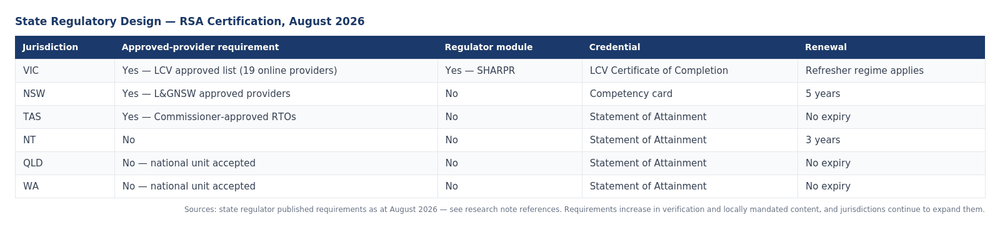
Regulatory design by jurisdiction
Placing Victoria in national context, the design features of each jurisdiction’s regime can be tabulated from regulator requirements [2][4][5][6][7]:
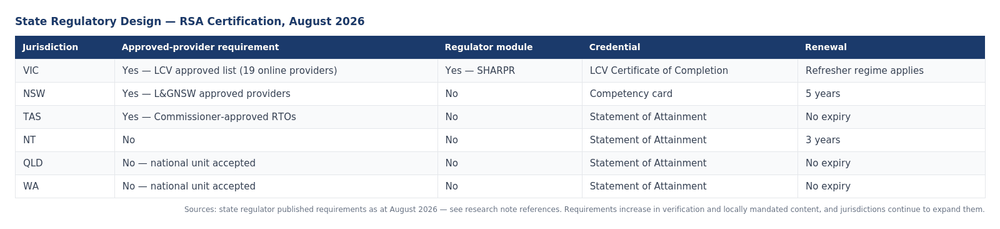
The table exposes a clean split: the two most populous hospitality labour markets — Victoria and New South Wales — both operate approved-provider regimes, while Queensland and the Northern Territory rely on the national layer alone. Gate-two regimes now cover Australia’s two largest hospitality labour markets, and the design elements added since 2020 have increased verification requirements and the scope of locally mandated content, and jurisdictions continue to expand them.
7. Limitations
Three limitations bound these findings. Register counts are point-in-time and change as RTO scopes change. Provider-level enrolment shares are not published, so concentration by volume cannot be measured from public data. And the NSW approved-provider pools — for RSA delivery and for the NSW Food Safety Supervisor certificate — were not counted for this draft; both counts are being verified against the published lists and will be included in the publication edition.
References
[1] Australian Government, training.gov.au — National Training Register, per-unit “Find RTOs” records at training.gov.au/Training/Details/{code}, accessed 6 August 2026: SITHFAB021 (1,237 RTOs); SITXFSA005 (1,385); SITXFSA006 (1,167); MLPLCA001 (accredited module — per-unit delivery counts not published).
[2] Liquor Control Victoria, Approved RSA course providers, https://www.vic.gov.au/approved-rsa-course-providers — list dated 5 August 2026; accessed 6 August 2026 and re-verified unchanged on 13 August 2026. Count of 19 approved online providers made by the author from the published list on both dates.
[3] NCVER 2026, Total VET students and courses 2025, NCVER, Adelaide, © Commonwealth of Australia, published 22 July 2026. https://www.ncver.edu.au/research-and-statistics/publications/all-publications/total-vet-students-and-courses-2025 (accessed 6 August 2026).
[4] Liquor Control Victoria — Responsible Service of Alcohol training requirements (two-step process effective 1 December 2025). vic.gov.au (Liquor Control Victoria).
[5] NSW Government / Liquor & Gaming NSW — Responsible Service of Alcohol training and Approved Training Providers: https://www.nsw.gov.au/business-and-economy/liquor-and-gaming/training/rsa and /training/find-a-training-provider (accessed 12 August 2026). Only L&GNSW Approved Training Providers may deliver NSW competency card training.
[6] NSW Food Authority — Food Safety Supervisor certification through approved RTOs (SITSS00069). foodauthority.nsw.gov.au.
[7] Tasmanian Government (Treasury — Liquor and Gaming) — Responsible service of alcohol course: RTOs approved by the Commissioner to deliver RSA with Tasmanian content; new staff must complete or be enrolled within 3 months: https://www.treasury.tas.gov.au/liquor-and-gaming/liquor/responsible-service-of-alcohol/responsible-service-alcohol-course (accessed 12 August 2026).
[8] Department of Local Government, Sport and Cultural Industries (WA) — Approved Manager requirement and mandatory RSA training for staff in licensed venues. dlgsc.wa.gov.au.
[7] Tasmanian Government, Department of Treasury and Finance (Liquor and Gaming Branch) — Responsible Service of Alcohol course requirements: courses recognised where delivered by RTOs approved by the Commissioner with Tasmanian content; new staff must complete or be enrolled within 3 months. https://www.treasury.tas.gov.au/liquor-and-gaming/liquor/responsible-service-of-alcohol/responsible-service-alcohol-course (accessed 12 August 2026).
Copyright, Disclaimer & Disclosure
© 2026 Access All Areas Training Pty Ltd (ACN 144 789 784). All rights reserved other than third-party material. NCVER data is © Commonwealth of Australia, reproduced with attribution in accordance with NCVER’s copyright and licensing terms. Register and regulator list contents change over time; all counts are point-in-time as dated, and percentage calculations are the author’s, computed from the cited figures.
This research note is general information only. It is not legal, financial or professional advice, and regulatory requirements must be verified with the relevant regulator before acting. To the maximum extent permitted by law, Access All Areas Training Pty Ltd accepts no liability for loss arising from reliance on this note. Analysis and interpretation represent the publisher’s views and are framed as such.
Disclosure of interest: Access All Areas Training is one of the 19 LCV-approved online RSA providers referenced in this note, and is NSW Food Authority approved provider 25813. This note may be cited with attribution: “Access All Areas Training (2026), The Two-Gate Market: Regulatory Concentration in Australian Hospitality Compliance Training, v2.1.” Figures must not be altered and quotations must not be presented in a misleading context. Corrections: errors identified after publication are corrected promptly and noted in a version history on the published page; notifications may be sent via accessallareastraining.com.au.